When Work Becomes Optional. What Musk Left Unsaid
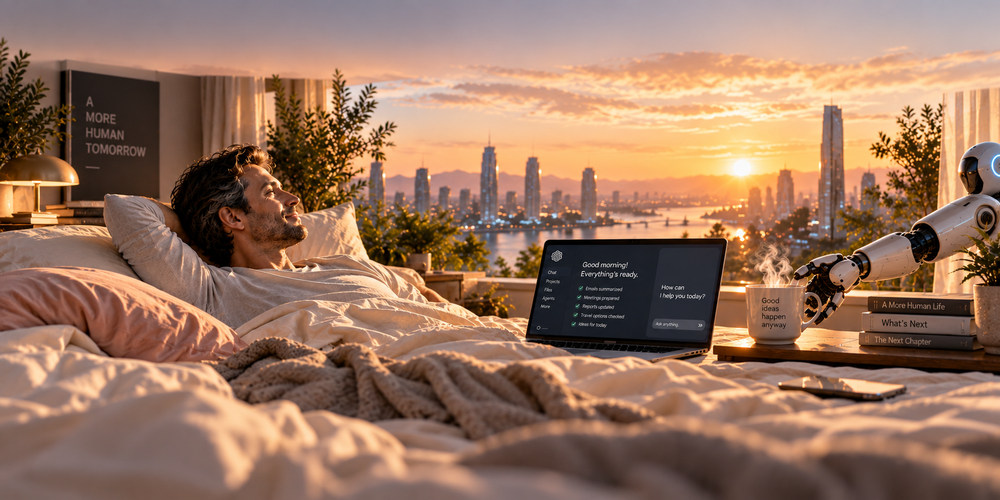
Imagine an ordinary morning.
You wake up and lie there for a few seconds with your eyes closed. The day is beginning outside. Cars are moving somewhere in the distance. The coffee shop downstairs is opening. Lights come on in the building across the street.
You reach for your phone, check the time — and suddenly remember: you don't have to be anywhere.
Not a weekend. Not a vacation. Not sick. You haven't lost your job, and you're not looking for another one.
Work simply isn't necessary anymore.
Not today. Not tomorrow. Not ever.
Almost the entire history of humanity has been an attempt to make life a little easier. First we invented tools. Then we put wind and water to work. Then we built machines. Then we taught machines to calculate.
Now we are teaching them to think.
Every new invention promised to give us a little of our time back. And we gladly agreed.
Let the machine do the heavy lifting. Let the computer calculate faster. Let artificial intelligence write, translate, analyze, plan. Let the robot cook our food, build our homes, drive our cars.
Let it.
At the end of that road looms an old dream: one day, human beings will no longer have to work in order to live.
It sounds wonderful.
But there is a question we ask far less often:
what will we do when the dream comes true?
What Musk Left Unsaid
Elon Musk has spoken more than once about a future in which work becomes optional. AI takes over intellectual labor. Robots take over physical labor. Goods and services become so cheap that having a job is no longer a condition of survival. People will still be able to work if they want to — much as some people grow vegetables in their own gardens today, even though it would be easier simply to buy them at the store.
One thing should be said plainly: the economic side of this prediction is a hypothesis, not a fact. No one yet knows how a society of abundance would actually distribute that abundance — not Musk, and not anyone else.
So from this point on, I'm not treating his prediction as a proven scenario. I'm using it as a frame for a different question.
Not whether it will happen, but what will happen to us if it does.
For thousands of years, we have tried to work less. We invented tools, domesticated animals, built machines, automated factories. Almost the entire history of technology is the history of trying to hand some part of human labor over to something else.
What if, one day, we take that idea all the way?
We Prepared to Lose Our Jobs. We Never Prepared to Gain Our Freedom
Today, almost every discussion about AI and employment is built around fear.
Which professions will disappear? Who will AI replace first? How many jobs will be left for humans?
Reasonable questions. But they begin with the assumption that work is primarily a way to make money.
That is true.
But it is not the whole truth.
Work does far more than anything written in an employment contract. It tells us when to get up in the morning. It determines our social circle. It creates hierarchies of achievement. It gives structure to our weeks, our years, and a large part of our lives.
And it helps us answer one of the most uncomfortable questions of all:
Who am I?
Try meeting someone new and going several minutes without asking what they do.
It is surprisingly difficult.
A profession has become one of the easiest ways to describe a person.
We appear to be talking about how we make a living.
In reality, we are telling each other much more.
That is why the disappearance of the need to work may turn out to be more serious than any technological revolution.
Imagine Musk Is Right
Let's set the timing aside for now.
Suppose the technical problem has been solved. AI performs most intellectual labor. Robots manufacture goods, build homes, maintain infrastructure.
Now imagine a person who no longer needs to work.
Not someone who has lost a job and is searching for another one. That is a different story.
This person is guaranteed housing, food, healthcare, transportation. Tomorrow morning, there is no need to go to the office.
The morning after that, either.
Never again.
The first few weeks would probably be wonderful.
You could sleep.
Travel.
Watch movies.
Read.
Finally do all the things you never "had time for."
And then Monday would come.
And for the first time in a very long time, Monday would be no different from Sunday.
Free Time and a Free Life Are Not the Same Thing
We are used to thinking of free time as an unquestionable good.
But today, free time exists in contrast to time that is not free.
A day off feels good because there is a working week. A vacation is precious because it ends. Even the celebrated pleasure of "doing nothing" feels good largely because, most of the time, we are required to do something.
If the obligation disappears forever, the meaning of freedom from that obligation changes as well.
A person doesn't gain a free evening.
They gain several decades that somehow have to be filled.
And that is where an economic problem becomes an existential one.
If I no longer need to work in order to live — what am I living for?
Technology will not answer that question.
We Are Very Good at Living by "Have To"
Much of human life is built around necessity.
You have to study. You have to earn money. You have to pay the mortgage. You have to provide for your family. You have to save for old age.
You can argue with that system, hate it, try to escape it.
But it has one enormous psychological advantage:
it constantly tells you what to do next.
The alarm goes off in the morning — and the question of the meaning of life can wait.
There's a meeting at ten.
A report due Friday.
A paycheck at the end of the month.
Another project after that.
Now imagine a world in which a significant part of those "have tos" disappear.
What remains is "I want to."
And we may discover that living entirely by "I want to" is much harder than we thought.
Because desire requires choice.
And choice demands an answer to a question that necessity allowed us to avoid:
What do I actually want from my life?
Perhaps Work Won't Disappear
If Musk is right, work itself may not disappear at all.
What may disappear is the obligation to work.
Those are two very different things.
People will continue to write books even though AI can write them faster. They will continue to cook even though a robot can do it more precisely. They will grow plants, build furniture, pursue science, make films, argue about philosophy.
Not because otherwise they won't be able to pay the rent.
But because they want to.
For the first time in thousands of years, work may begin to separate from the necessity of survival.
It sounds almost utopian.
But this is exactly where the hardest question appears.
Today, the market tells us — rather crudely, but quite clearly — that what we do is needed by someone: they are willing to pay for it.
In a world where work is optional, that measure becomes weaker.
People will have to decide for themselves whether what they do has meaning.
And that is an entirely different level of responsibility for one's own life.
AI May Take Away Our Best Excuse
There is a sentence every one of us has said dozens of times:
"I don't have time."
No time to write a book.
Learn a language.
Make music.
Spend more time with our children.
Start that personal project we've been thinking about.
Simply think.
Work is one of the most convincing explanations for why we are not living the life we imagine we might live someday.
But imagine that excuse disappears.
Now there is enough time.
And suddenly an even more uncomfortable question appears:
Was time really the problem?
Without a boss. Without a work schedule. Without the need to prove our worth through the size of a paycheck. Without the eternal promise of "someday" — we are left alone with ourselves.
That may turn out to be both the greatest liberation and a serious trial.
We Will Need a New Culture of Adulthood
We talk a lot about the skills people will need in the age of AI: critical thinking, working with models, creativity.
But if Musk's prediction comes even partly true, we will need another skill — one that almost no one teaches today:
the ability to create meaning for oneself, on one's own terms.
Not to receive it along with a job title.
Not to measure it by a career ladder.
Not to postpone it until retirement.
Today, an adult is someone who can support themselves.
Tomorrow, that may no longer be enough.
An adult will be someone who knows what to do with their own freedom.
What He Still Left Unsaid
Perhaps it wasn't his job to say it.
An engineer's view naturally focuses on the engineering problem: how to make intelligence cheap, how to automate labor, how to turn scarcity into abundance.
These are enormous challenges.
But once they are solved, we enter a territory where neither a neural network, nor a robot, nor an economy of abundance will be able to make the decision for us.
Technology may free us from the need to work.
But it cannot tell us what to do with the life that has been set free.
For a long time, we have feared a future in which a machine would ask:
"What do I need humans for?"
But perhaps, long before that happens, humans will have to ask themselves:
"If there is nothing I have to do anymore — what do I want?"
Let's return to the morning where we began.
You are still lying there with your eyes closed. Outside is the same city, the same cars, the same coffee shop downstairs. Nothing has changed out there.
Only one thing has changed:
the question your alarm clock used to answer for you is now yours to answer.
And, as usual, after login, everything only begins.
Stay Updated
New essays from After Login, about once every two weeks. New publications only. No promotional mail.
The Conversation Continues in the Lounge
The article ends here, but the conversation doesn’t. In the project Lounge, you can discuss what you’ve read, disagree with the author, reply to other readers, or start a topic of your own.
After Login, everything is just beginning.