The Life Behind a Song
What lies behind music in the age of AI
Part 1
When Music Becomes Endless, What Are We Actually Listening To?
AI can already write a decent song. And perhaps that is precisely why the human life behind music will become ever more valuable.
On September 25, four men returned to a school in Dublin.
They had been there before. Fifty years earlier.
In 1976, fourteen-year-old Larry Mullen Jr. pinned a note to the noticeboard at Mount Temple Comprehensive School in Dublin: “Drummer seeks musicians to form band.” A few days later, a rather odd bunch of schoolboys gathered in his kitchen.
They could barely play.
In time, they became U2.
Fifty years later, on September 25, 2026, Bono, the Edge, Adam Clayton and Larry Mullen were back, playing in that same schoolyard.
There is something almost defiantly old-fashioned about this story. Teenagers meet. Learn to play together. Make mistakes, argue, change, grow older, and still manage to record good albums. Fifty years pass. And one day they return, in person, to the place where they met.
You cannot get that story from a single prompt.
And that is precisely why it matters in a conversation about technology.
Making music is becoming incredibly easy. Until recently, between the idea for a song and the song itself stood musicians, instruments, rehearsals and a studio. Now, increasingly, a few lines of text will do.
The obvious question is: will AI eventually make music as well as a human can?
I increasingly suspect that is the wrong question.
Suppose it can. What then?
There Has Always Been More to a Song Than Sound
And not just for the people who write it.
A few weeks before U2 returned to their school, the writer Chloé Caldwell told a very different story about music.
After her divorce, she was cut off from the stepdaughter she had helped raise.
Before the divorce, Chloé had made the girl a Spotify playlist for her thirteenth birthday. When they were separated, she kept adding songs.
There were no more conversations. No more ordinary evenings together, either. The playlist remained.
Chloé wrote that she liked imagining them listening to the same song at the same time.
Technology did not save their relationship. But it allowed a trace of it to remain.
Spotify had not created their relationship. Songs could not restore it. And, of course, a playlist was no substitute for seeing someone you love.
For Chloé, it remained a way of reaching out to the girl, even when she did not know whether those musical messages were getting through.
Later, when they were back in touch, the girl asked about the old playlist. She had been looking for it, too.
Now take away that story and leave only the playlist.
The sound will be exactly the same. But something essential will be missing.
That is why the conversation about AI music is more complicated than the familiar argument over whether a machine can compose a convincing melody.
Music has never existed solely within a recording.
Some of what we hear lies outside it.
But there are two different stories here. One is the life of the person who wrote the song. The other is the life of those who listen to it. They can meet in a single recording, but they do not have to. Even a song made by a machine can become a reminder of a thoroughly human love.
Along with the sound, we take in who made it, when, and what was happening in that person's life before the song. Sometimes, we also hear what was happening in our own lives when we listened to it.
A file holds sound.
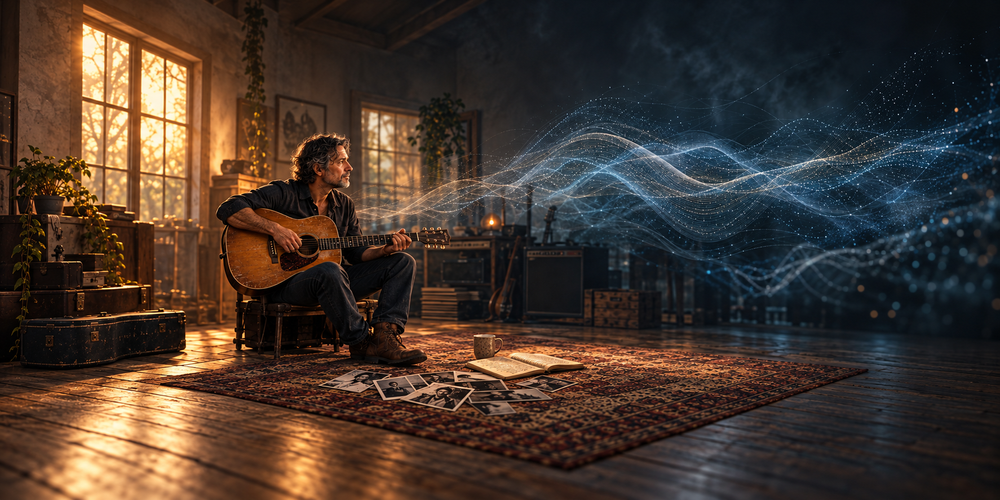
A song can hold a life.
AI Has Never Had Its Heart Broken
Recently, Sting put this difference much more simply.
Speaking to the BBC, he acknowledged that AI can already make serviceable pop music. His objection was not that a machine would necessarily write a bad melody or produce a clumsy arrangement.
AI has never had its heart broken.
“It doesn’t have a story, it has a borrowed story,” Sting said.
For several years, the conversation about AI and creativity has been a contest between results.
Can AI write a good song?
A novel?
Can a listener tell the difference?
These are understandable questions. But as the technology develops, they become less useful.
If an AI-generated song moves me, the machine's lack of personal experience does not cancel my response. The listener is human, after all. The feeling can be real even if its source is synthetic.
Here I disagree with Sting. Just because a machine has no feelings of its own does not mean its song cannot make me feel something.
And a human song does not have to be autobiographical. A songwriter can invent a character, tell someone else's story, imagine a feeling. Their contribution also lies in what they notice and how they express it.
But that leads to a different conclusion.
It seems we care about where an emotion comes from, even when we cannot identify its origin from the sound alone.
The Human Premium
The composer Michael Whalen recently used the term human premium for this idea. The extra value that comes from being human.
His argument begins with abundance.
AI can produce vast amounts of perfectly decent music. One more ambient track, one more pop song, one more piece of background music no longer requires much money, time, or even serious technical skill.
When music of an acceptable standard becomes practically limitless, being acceptable alone is no longer worth much. And the competition changes.
A musician who plans to compete with a machine on speed and quantity has chosen a particularly unfortunate opponent.
The machine does not get tired. It does not lose confidence after a bad review.
It does not spend three days agonizing over a revision that didn’t work, trying to decide whether the chorus was better in the first version.
And it does not have to pay rent.
But a glut always raises the value of what is becoming rarer.
When millions of technically competent songs surround us, a different question gradually starts to emerge: less “Is this good music?” and more “Why does this particular song matter to me?”
Whalen talks about a recognizable artistic point of view. It appears in the music itself: what someone kept, what they discarded, where they dared to take a strange turn. We can hear those decisions without knowing anything about their life.
Biography adds something else. The song already existed, and we liked it. Then we learned about the circumstances in which it was written. The sound stayed the same. We began to hear it differently.
Not a flourish added to its meaning. Part of its meaning.
Knowing who created a work changes our relationship with it.
The fifty years behind U2's return to Mount Temple cannot be separated from what happened in that schoolyard. The chords were no different for being played where the musicians had met as teenagers.
In Chloé Caldwell's story, life enters music from the other side. What matters here is the story of the woman choosing the songs and the girl they were meant for. We may know nothing at all about what the songwriters themselves had been through.
The meaning changed.
The playlist's value does not lie in the sequence of recordings. Anyone could put together exactly the same playlist in a few minutes.
You can copy every song. But you cannot copy what that playlist meant to two particular people.
So Chloé's story, on its own, proves nothing about the superiority of human songwriting. It shows how a song becomes part of someone else's life. And that can happen even with music made by AI.
But the question for the songwriter remains: what, exactly, did they contribute to the song?
Where Do We Draw the Line?
There is a vulnerability in this argument: what happens when a human uses AI?
The independent musician PeppDigital, who openly uses AI in his work, proposes a different dividing line.
For him, the question is not whether a human directly created every sound. He sees his authorship in the ideas and decisions: developing a concept, writing and reshaping material, determining the structure, mood and direction, with technology as part of the process.
This is harder to dismiss than the familiar phrase “AI is just another tool.”
Because the line really is shifting.
Sting talks about lived experience. Whalen about a recognizable artistic point of view. PeppDigital explains which decisions he considers his contribution, even when he uses AI.
These positions overlap. But a biography does not by itself tell us how much someone did in a particular song. And the number of notes they played does not explain why the song became important to me.
A musician may have a rich human biography and generate most of a track with AI. Another may play every instrument themselves, yet their music tells us almost nothing about who they are.
Whose work, then, has more of this human premium?
I do not have an answer.
But that question is far more interesting than arguing over whether AI has a right to be in music. It is already there.
The argument has moved on.
What Were We Actually Measuring?
For more than a century, recorded music has gradually been separating itself from the human body that produced it.
First, a musician no longer had to be in the room for us to hear them.
Then we no longer needed a record.
Then we no longer needed to own a music file.
Now we are approaching another rupture: a song can come into existence without a person behind it.
At first glance, this looks like the final triumph of music existing on its own. But the result may be the opposite.
When you can get a song for almost nothing, you start looking not just at the song itself but at where it came from.
We have long known this from other things. A handmade object is valuable in part because a person made it. Physically, a signed book is hardly different from an unsigned copy. A concert recording contains roughly the same notes that were played in the venue, but nobody would think of treating the two experiences as identical.
Something similar may happen with music.
Not all music, of course. Probably not even most of it.
We use enormous amounts of music without taking any interest in who made it. We run with it on, work to it, walk through shops with it playing, fall asleep to it.
But with the music we grow attached to, things may be different.
We will want to know whose voice this is.
Who wrote the song? Why? What was happening in their life? Were they seventeen or seventy? Did they really feel this?
And more and more often, one more question will come up:
Was there anyone there who had something to feel in the first place?
This does not make AI-generated music meaningless.
It makes us look at human authorship differently.
For almost the entire history of recorded music, a person behind a song was a given. There was no special premium for that: no alternative existed.
Now there is an alternative.
And when something stops being a given, we begin to notice it.
In that world, four musicians standing in their school again after fifty years look a little different.
So does a woman adding songs to a playlist because it was the only way to reach a child she loved.
Neither story proves that a human will write better music than a machine.
Both tell us something else.
There can soon be as many songs as you like.
But the life that made one of them mine cannot be copied along with the recording.
Is there a song in your life that you cannot explain by saying “I just like the music”? Whose life lies behind it—the songwriter's, yours, or that of someone you remember?
After login, everything is just beginning.
Stay Updated
New essays from After Login. New publications only. No promotional mail.
The Conversation Continues in the Lounge
The article ends here, but the conversation doesn’t. In the project Lounge, you can discuss what you’ve read, disagree with the author, reply to other readers, or start a topic of your own.
After Login, everything is just beginning.