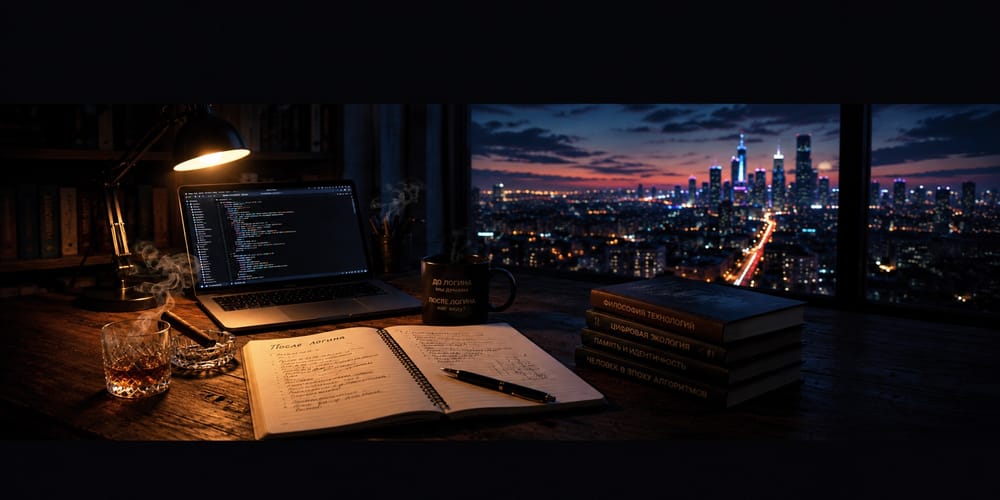
About the Project. The Story Behind “After Login”
Every project has two origin stories: the official one — and the real one.
The official version would sound elegant enough: “I spent a long time studying the modern media landscape, noticed an open space somewhere between philosophy and technology, and decided to create a platform for thoughtful long-form writing…”
A fine paragraph for a business plan.
But we are not sitting in a boardroom. We are in a living room.
So I will tell you the real story — about how one short sleepless night and one forgotten password forced me to rethink where all of us are drifting.
The Night I Lost My Digital Double
It happened about a year ago.
I woke up at three in the morning with a strange feeling of anxiety. You know that state when the mind refuses to sleep and starts throwing the hardest questions about life at you?
To silence that inner voice, I did what half the planet now does automatically: I reached for the smartphone on my nightstand.
I wanted to log in to an old account where I had kept archives of my texts, notes, and photographs from ten years earlier. My own little digital vault of memory.
The screen blinked and displayed: “Session expired. Enter password.”
I entered the password.
Wrong.
Then another. And another. A third. A tenth.
My mind frantically searched through combinations of letters, numbers, and symbols that had once seemed impossible to forget.
I clicked “Recover by email” — only to discover that the old email address was linked to a phone number I had not had for years.
After half an hour of useless attempts, the system finally locked me out with a cold, final message:
“Access denied.”
I put the phone down, but sleep was gone.
In the darkness of the room, a sharp and frightening realization hit me:
In one second, a huge piece of my life had simply stopped belonging to me.
My thoughts, my memories, my writing were locked inside someone else’s server, cut off from me by a lifeless algorithm.
That was when I understood how vulnerable we had become.
How fragile our idea of “ownership” really is in this glossy world of beautiful interfaces, where behind each of us a personal door can quietly close.
A Man of Two Worlds Before a Glowing Screen
That sleepless night was when I began to think seriously about how technology changes our existence.
I am sixty-five.
Half of my life was lived in a completely analog world. I remember a time when information had physical weight: books stood on shelves, vinyl records had to be carefully taken from their sleeves, and letters smelled of paper and ink.
If you bought something, it was yours.
No one could erase it remotely. No one could block it because of some “violation of a license agreement.”
In the second half of my life, I stepped — along with the rest of the planet — into the digital ocean.
And I sincerely admire progress. I love that I can listen to almost any music in the world, speak across oceans, and use the astonishing possibilities of artificial intelligence.
But as a man of two worlds, I can also see the price of this convenience far too clearly.
Without really noticing it, we have handed corporations the right to manage our memory, our time, and — most importantly — our attention.
Social media algorithms skillfully ration our emotions, feeding us clickbait and momentary noise. We have been trained into shallow, fragmented consumption, where there is almost no room left for silence, depth, or independent thought.
How This House Was Built
That night with the forgotten password became the final straw.
I realized that I no longer wanted to be a passive tenant on someone else’s digital platforms.
I wanted to regain control and sovereignty over my own digital life.
That was the beginning of a personal journey that many people my age would probably call pure madness.
I had no background in IT. But I started from scratch, learning how the internet works from the inside.
I rented my own virtual private server in a European data center. I learned how to set up DNS records, configure traffic encryption, protect my data, and understand the basic infrastructure behind the screen.
This website — the one you are reading now — I built myself, on an independent platform.
There are no outside algorithms here deciding what you should read.
There are no intrusive ads trying to steal your attention.
This is my small, sovereign, comfortable digital home.
Why We Are Here
This project is my personal manifesto for our right to a slower, more thoughtful life in a world that has gone slightly mad.
It is for people who want to use gadgets and technology fully, but who absolutely refuse to surrender their humanity, their critical mind, or their inner silence.
Today, on the day of its launch, this House still smells of fresh paint on a virtual foundation. And on its shelves there is only the first — but most important — text: our Editorial Manifesto.
This is the starting point.
Gradually, week by week, new long reads will appear here: detailed essays on digital anthropology, media hygiene, the paradoxes of internet ownership, and how not to lose genuine human closeness in an age of total online connection.
I do not want to rush.
I want every text here to invite slow, attentive reading — preferably with a cup of coffee nearby.
I am creating this space in the hope of meeting kindred spirits: people who miss honest, difficult conversations without falsehood, noise, or hype.
The world around us is changing too quickly.
We cannot stop these changes. We cannot simply abandon the internet.
But we can change the way we behave inside it.
Sometimes we need to pause, step out of the endless stream of notifications, and simply talk.
We are making this login together.
And we really do have something to discuss.
Welcome to our digital home.
The Conversation Continues in the Lounge
This page ends here, but the conversation doesn’t. In the project Lounge, you can discuss the ideas behind After Login, ask the author a question, share your experience, or suggest a new topic.
After Login, everything is just beginning.