The Renaissance of Curiosity: How AI Restored My Childhood Wonder
Most discussions surrounding artificial intelligence today revolve around efficiency. We are constantly encouraged to speed up workflows, delegate routine tasks, optimize code, or generate gigabytes of content in seconds. Yet, if we strip away the marketing noise and examine AI through the lens of human experience, its most profound breakthrough isn't economic at all.
It is humanistic.
The most unexpected gift neural networks gave me was not saved time, but a feeling I thought had been permanently left behind in my distant past.
AI gave me back a sense of endless, boundless childhood curiosity.
A Time When the World Was Immense
Back in the 1970s, when I was a child, the world felt impossibly vast and filled with mysteries. The thirst for new knowledge and experiences wasn't an obligation; it was the natural state of being. I wanted to try absolutely everything.
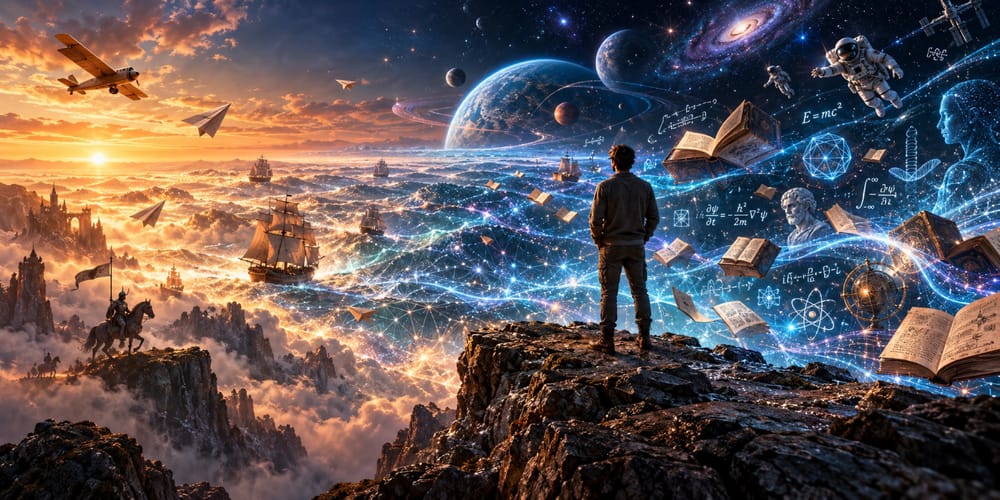
My days were packed with hands-on exploration: youth sports — wrestling, swimming, water polo; technical clubs where we crafted wooden models of planes and ships, practiced woodcarving, and experimented with early shortwave radios. And in the evenings, with bated breath, I immersed myself in books. I embarked on crusades alongside knights, explored eerie anomalies with the Strugatsky brothers, wandered the red deserts with Ray Bradbury, learned the laws of robotics from Isaac Asimov, and marveled at outer space in the paintings of Alexei Leonov — the first human to walk in space.
There was enough passion and excitement for everything. Except for schoolwork, of course.
Back then, the primary limits were physical: club schedules, the availability of a specific book in the local library, and the distances a teenager could travel. But the possibility of exploring the world felt limitless.
The Trap of Specialization and the Fear of Looking Foolish
Then came adulthood. Career, family, social obligations, and the endless stream of daily responsibilities.
Over time, I noticed my own range of interests beginning to narrow. Society demands clarity and tight specialization from an adult. We become experts in our chosen niche, but gradually lose touch with other domains of life. The vibrant variety of childhood experiences gives way to a clear, yet rather narrow corridor of professional existence.
However, there is a second, more insidious barrier that emerges with age: the social fear of demonstrating incompetence.
In the adult world, status obliges us to "know." We often nod along in meetings or social gatherings when complex economic concepts or emerging technologies are discussed, even though internally we realize we don't fully grasp the topic. We feel uncomfortable raising a hand to ask: "Wait, why are we worrying about inflation if we can just print more money?" or "Can someone explain in simple terms how a quantum computer actually differs from a regular one?"
We remain silent to avoid looking foolish. Our curiosity hits the wall of our own pride and fear of judgment. As years pass, potential hobbies and fascinating topics are deferred to an indefinite "someday," while the boundaries of our world shrink down to a few familiar routines.
A Judgment-Free Dialogue
And then artificial intelligence entered the picture.
The first thing I discovered while interacting with neural networks was the freedom to ask questions without worrying about looking foolish. The conversational interface of AI turned out to be an ideal space free from social pressure.
AI doesn't care how old you are, what your status is, or how simple or naive your question might be. With it, you can drop the mask of the "all-knowing adult" and start completely from scratch. You can ask: "Explain the theory of relativity to me as if I were ten years old." And when it answers, you can honestly admit: "I still didn't get it. Let's try again, but use analogies with building blocks or trains."
And it will explain — without irritation, without sighing, and without a trace of superiority.
This simple absence of judgment removes the primary psychological barrier. You regain the right not to know. You become an explorer once again, allowed to ask "foolish" questions.
Standing at the Edge of the Knowledge Ocean
By eliminating the fear of looking incompetent, AI simultaneously removed the technical friction between having a thought and exploring it.
Previously, diving into an entirely new field — whether astrophotography, genetics, 3D modeling, or the philosophy of consciousness — required spending weeks just figuring out where to start. Finding books, selecting courses, deciphering terminology, filtering out the noise.
Today, all it takes is opening a MacBook or pulling a phone out of your pocket.
I often go to sleep now with the sensation of standing at the edge of a high cliff, overlooking an endless, mesmerizing ocean of knowledge. You can choose any direction: explore neural network architecture today, dive into ancient civilizations tomorrow, and attempt to grasp quantum mechanics the day after. The main thing is simply deciding to jump.
Every answer doesn't close a topic; it opens ten new doors. You start with a single simple question, and two hours later, you find yourself in an entirely unexpected domain of knowledge, having completely lost track of time.
The Real Gift of Technology
Of course, we shouldn't harbor illusions. AI can make mistakes, hallucinate, and state inaccurate facts. It cannot replace genuine real-world experience, rigorous academic discipline, or personal effort.
Artificial intelligence doesn't automatically make a person smarter. But it does something far greater: it makes us hungry for knowledge again.
In my childhood, I was constrained by distances, schedules, and book availability. Today, many of those old barriers have disappeared, and access to knowledge has become incomparably easier. The only true remaining constraint is time. There are still only 24 hours in a day, and realizing that becomes more frustrating with each passing day.
And yet, watching technology transform our world, I reflect on how we too often measure progress solely in terms of money and productivity. Perhaps the most extraordinary gift of artificial intelligence is that it restores our status as Homo Curiosus — the Curious Human.
It simply reminded us that the world around us is just as breathtakingly vast, complex, and beautiful as it was when we were children. And that exploring it completely is impossible.
Which means the most exciting journey is still ahead.
How has AI changed the way you learn? Have you used it to explore something you once found intimidating, or is it still mainly a work tool for you? Join the conversation in the comments.
After login, everything is just beginning.
Stay Updated
New essays from After Login. New publications only. No promotional mail.
The Conversation Continues in the Lounge
The article ends here, but the conversation doesn’t. In the project Lounge, you can discuss what you’ve read, disagree with the author, reply to other readers, or start a topic of your own.
After Login, everything is just beginning.