The Shadow of Digital Consent. Prologue: When an AI Ad Is Scarier Than AI Itself
oday, July 16, marks AI Appreciation Day.**
It is an unofficial observance established by A.I. Heart LLC in 2021 to encourage people to reflect on how artificial intelligence is already reshaping everyday life — from music recommendations to assisting doctors.
Just a few days before this year's observance, something happened that now feels almost symbolic.
One of the world's leading AI companies, Anthropic, released a short film titled "There's Hope in Hard Questions."Instead of celebrating the latest technological breakthroughs, it invited viewers to confront their consequences.
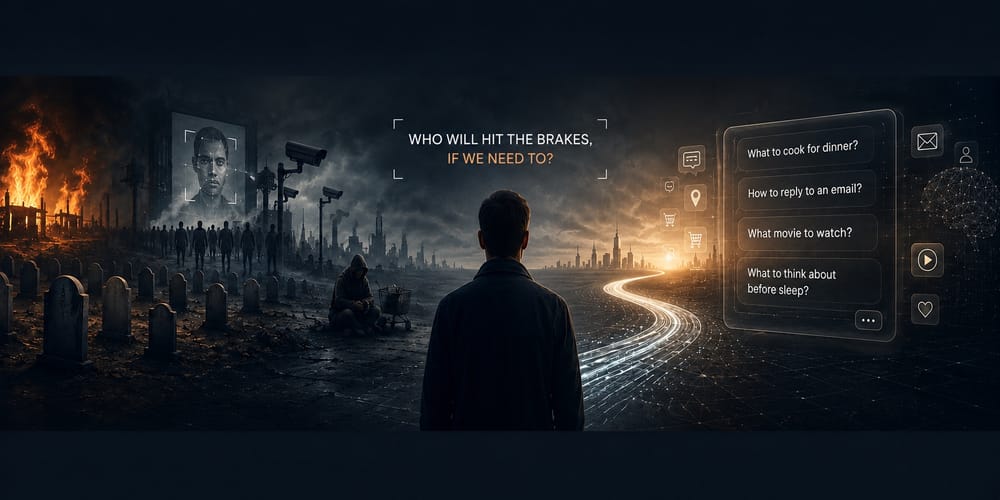
Rather than offering familiar promises about the future, the film shows a graveyard, surveillance cameras, a raging fire, and asks a single unsettling question:
"Who hits the brakes if we need to?"
What came out wasn’t “we’re honestly staring into the abyss.” It was closer to “why are you showing me a graveyard when I just wanted to ask a chatbot for a borscht recipe.”
The reaction was almost unanimous. Viewers said the ad looked like a parody, not an advertisement. Even Sam Altman, head of rival OpenAI, couldn’t resist — he wrote on X that he assumed it was satire and kept checking whether the handle was misspelled, as if this were some fake, parody account.
It’s a symptom.
Speaking Different Languages About the Same Risk
Anthropic is a company that has genuinely spent years talking about the risks of powerful AI in dead earnest, up to and including scenarios of existential threat to humanity. Inside that corporate culture, talk of graveyards and “hitting the brakes on civilization” is routine — part of the daily discourse. The problem is that the viewer watching the ad doesn’t share that routine. For them, a tech-product commercial that cuts real military-cemetery footage against the voice-over question “who’s going to hit the brakes” isn’t courage. It’s either black comedy, or a warning sign that the company itself no longer understands the line between the internal language of AI-safety debates and the language you use to talk to an ordinary person scrolling their feed.
This is where the real lesson of the story lies — and it’s not a lesson about marketing, it’s one about perception. A company that stews in conversations about existential risk every single day risks losing touch with how those images land on someone who isn’t part of that conversation. What reads as honesty to one person reads as panic with no way out to another.
And If Tomorrow Everyone Starts Saying It
Let’s say the Anthropic ad is just an unfortunate one-off. Let’s say that in six months every major AI company starts making similar ads — a bit more tasteful, no graveyards, but the same underlying pitch: “we know this is dangerous, trust us.” Would anything fundamentally change?
No. Because the question this ad supposedly raises — “can AI be trusted” — isn’t actually the most interesting question available. It’s too broad and too convenient: you can answer it forever with press releases, promises, and handsome commercials about responsibility. There’s a different question, far more interesting and far closer to real life, that the ad never asks at all:
What happens to a person when they voluntarily hand more and more of their own decisions over to algorithms?
Not “is AI dangerous in general,” but what happens to me, specifically, when for the sixth time today I ask an algorithm what to eat, what to write back to a colleague, what movie to watch, what to think about before falling asleep. No one is forcing me to do this. I do it myself, voluntarily, one step at a time, each time a little more convenient than the last.
The Shadow of Digital Consent
Anthropic chooses to begin the conversation with the risks of AI. That approach has substance, and it’s honest in its way — the company really has spent years investing in AI safety, and one failed ad campaign doesn’t erase that.
But I want to say something else.
AI can be genuinely useful. Truly useful — it clears away routine, helps us think, saves hours of our lives. The problem isn’t the tool itself. The problem is that some of our decisions we hand over to it not because we’re forced to, but because it’s easier. And that voluntariness is exactly the thing happening to us right now that’s hardest to notice.
That’s the subject of the article series I’m starting here, on After Login — “The Shadow of Digital Consent.” Not about machines rising up, not about the “stop” button Anthropic’s ad keeps circling back to. About a much quieter process: how we, generation after generation, keep agreeing to hand over more — first the route, then the purchase, then the opinion, and maybe eventually the decision about who to be friends with and what to believe. No one makes a graveyard commercial about that, because it doesn’t look frightening. It looks like an ordinary environment.
And an ordinary environment is the most dangerous place to try to notice anything, because inside it, you don’t feel like looking for a problem.
The Anthropic ad didn’t fail because it was too honest. It failed because it handed the viewer a ready-made fear instead of an invitation to look at themselves. Fear ends the moment you turn off the video. Noticing doesn’t.
Maybe that’s exactly why it feels important to me to start this conversation now.
Not because I’m afraid of artificial intelligence.
But because I don’t want to wake up one day and find that the most important decisions of my life have become so convenient to make that I stopped noticing the moment of consent itself.
Where exactly is the line between convenience and delegation — and can you even notice the moment a decision stops being yours?
Stay Updated
New essays from After Login, about once every two weeks. New publications only. No promotional mail.
The Conversation Continues in the Lounge
The article ends here, but the conversation doesn’t. In the project Lounge, you can discuss what you’ve read, disagree with the author, reply to other readers, or start a topic of your own.
After Login, everything is just beginning.