Outsourcing Our Thinking, or: Is AI Really Leading Humanity Toward Decline?
Turn 1. The Trap of the Perfect Answer
It seems we’ve finally got what generations of schoolchildren, university students, and anyone who works with words and ideas have dreamed of. Press a button, and three seconds later you have a flawless essay, a polished analytical report, or a ready-to-run Python function.
Recently, some alarming figures about how generative AI is undermining learning went viral on social media. Behind the hype is a real, large-scale study by economists David Strömberg, Victor Lei, and Yanhui Wu, published by the Centre for Economic Policy Research (CEPR Discussion Paper No. 21577). The June 2026 working paper follows nearly 27,000 Chinese students in grades 7 through 12 over thirty months. All of them came from a single county. One county isn’t the whole world, and that’s worth remembering.
At first glance, the results look like a technological triumph:
- Time spent on homework fell from 64 to 45 minutes, almost a third less.
- Homework grades rose by an average of 18%.
A victory? More time freed up for creativity?
But take one more turn, and the road suddenly drops away.
On closed-book exams, with their devices taken away and nothing left but a blank sheet of paper and their own brains, students who regularly used AI saw their scores fall by 20% within just six months. On entrance exams, the decline ranged from 18% to 24%, with the full effect taking roughly two years to emerge.
For two years, it looked like a victory. Then the bill came due.
The central problem became clear: when you get a finished result without struggling to find the right words, making mistakes, and working your way through them, you may never learn what the task was supposed to teach you. The result is there. The skill isn’t. You still haven’t learned. You’ve simply been a passenger in someone else’s car.
Turn 2. The Elite Firewall and the Digital Caste Divide
This is usually where the prophets of doom make their entrance: “That’s it! The trap has snapped shut! The masses will turn into mindless dopamine addicts, hooked on neural networks, while the elite rules over a helpless world!”
And there’s a grain of truth in that argument. Silicon Valley, the world’s great factory of digital algorithms, offers a revealing example. Back in 2011, The New York Times reported on the Waldorf School of the Peninsula in Los Altos. Its students included children of employees from Google, Apple, Yahoo, and eBay. Yet there were no computers in the classrooms. Instead: printed books, chalkboards, drawing, hands-on crafts, and actual human interaction.
Something similar happens at certain elite private schools in Britain and the United States, where smartphones are collected during lessons or students are encouraged to switch to basic feature phones.
Does this mean the “masters of the universe” are creating exclusive conditions for their own children while feeding everyone else free AI slop?
Let’s slow down around this bend and take a closer look.
The elite aren’t rejecting technology itself. They’re rejecting technological dependence at an early age. Some parents who understand digital technology better than most prefer to teach their children how to function without it first, and only then introduce tools capable of replacing part of their mental work. They’re investing in the foundations: the ability to concentrate, think deeply, and tackle difficult problems independently.
Turn 3. The Great Historical Cycle of Panic
To understand what’s happening now, it helps to look back. The fear that new technologies will make us collectively stupid has accompanied almost every major technological change.
- Writing. Socrates, as portrayed by Plato, worried that writing would destroy memory. People would stop remembering things themselves and start relying on marks on a page.
- The printing press. In the fifteenth century, Gutenberg’s printing press was seen as a threat to the mind: people would no longer need to memorize texts.
- Calculators and search engines. In the 1970s, teachers worried that pocket calculators would destroy children’s arithmetic skills. In the 2000s, Google was accused of teaching us to stop retaining knowledge in our own heads.
(I’m deliberately leaving out the theatre, which was supposedly going to be killed by cinema, and cinema, which was supposedly going to be killed by television. Those fears were about ticket sales, not intelligence. And neither theatre nor cinema died, by the way.)
But here’s the thing: Plato was partly right. Writing really did change memory. We became worse at memorizing and better at storing knowledge outside our heads. We didn’t stop thinking; we shifted to a different level of abstraction, and every technology took something away and gave something in return. The question isn’t whether those fears were foolish. It’s what we’re losing this time. And this time, at least, researchers have managed to measure some of the loss. You’ve just seen the numbers.
The real dividing line runs not between paper and screens, but between how we use the tool.
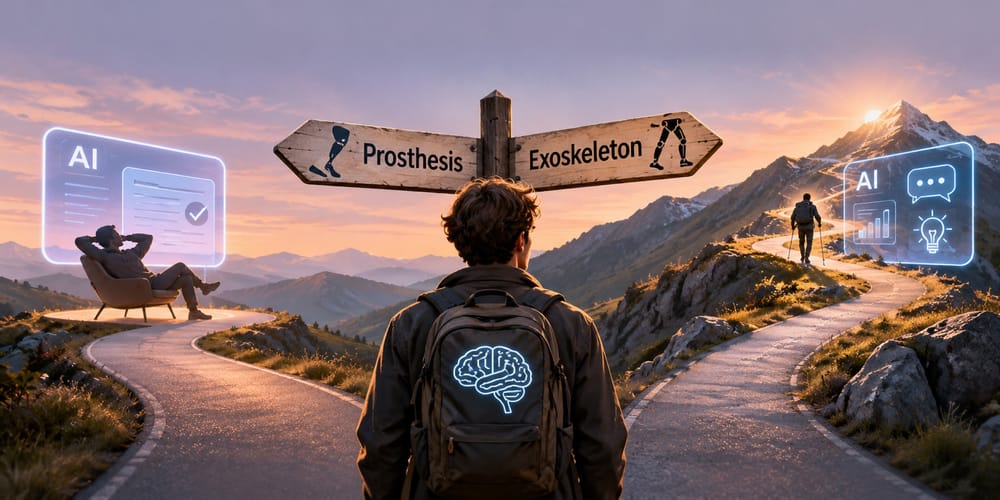
Turn 4. Prosthesis vs. Exoskeleton
We’ve reached the most important turn on this winding road.
The real danger of AI isn’t the algorithm itself. It’s the role we assign to it:
- AI as a Prosthesis. You tell a neural network: “Write my article for me.” “Come up with a solution for me.” “Draw the conclusion for me.” At that moment, you’re outsourcing the most valuable part of the work: the thinking itself. Your brain switches itself off as unnecessary. You become an operator of someone else’s ideas.
- AI as an Exoskeleton. You use AI as an opponent, a Socratic conversation partner, an ideal assistant: “Here’s my idea. Find its weaknesses.” “What arguments challenge this hypothesis?” “Help me gather the facts, but I’ll draw my own conclusions.”
And this isn’t just a neat metaphor. In the same study, the learning losses were concentrated among roughly 80% of AI users: those who completed homework unusually quickly while earning high marks. Students who spent about as much time on homework as classmates who didn’t use AI lost relatively little. A fair caveat: the researchers could only observe indirect signs, such as time spent and grades. They couldn’t see exactly what students were asking the AI to do. Still, the pattern looks remarkably like our two categories.
Let me make one thing clear: a prosthesis isn’t inherently bad. For someone without a leg, it may be the only way to walk. The trouble starts when you fit a prosthesis to a perfectly healthy leg.
I’ve experienced both sides of this myself. Wikipedia answers questions you already know how to ask. A neural network showed me what I could ask about in the first place: entire fields of knowledge I hadn’t even known existed.
Where I’d been blind, it gave me sight.
That was a prosthesis, and I’m not ashamed of it. There was no leg there to begin with.
AI became an exoskeleton for me when I started using it to understand my medical test results. It explained unfamiliar indicators, helped me see possible connections, and suggested hypotheses. I checked them with my doctors, and in my case their assessments matched.
But something else turned out to be far more valuable. I started arriving at appointments prepared, knowing what I wanted to ask and what I needed to understand. Once, a doctor and I spent half an hour of an appointment discussing not my test results, but how artificial intelligence can help physicians work through difficult cases.
AI didn’t replace my doctor. It changed the nature of our conversations. I was no longer coming in as a petitioner, but as a conversation partner.
A prosthesis on a healthy leg leads to decline. An exoskeleton amplifies your thinking.
Turn 5. The Paradox of the Next Lomonosov
Some people argue that neural networks will prevent the emergence of another Lomonosov or Tsiolkovsky, brilliant self-taught minds who rose from humble beginnings. The ordinary person, we’re told, will drown in a sea of effortless answers.
But what if things are more complicated than that? What if, in some respects, the opposite is true?
In the past, reaching advanced knowledge meant overcoming countless barriers: rare libraries, inaccessible academic departments, years spent searching for the right books. Today, anyone with enough curiosity, anywhere in the world, can have a personal tutor in quantum physics, structural mechanics, or Renaissance art, available to answer questions around the clock.
The barrier to knowledge has fallen dramatically. But the price of your own intention has gone up.
And we should be honest about something else: talent alone offers no protection. In the same study, the losses were especially severe among high-performing students and younger pupils. Apparently, it’s no harder for a gifted person to strap a prosthesis onto a healthy leg than it is for anyone else. Intelligence isn’t what protects you. What protects you is the habit of refusing to settle for a ready-made answer.
The Lomonosov of the twenty-first century won’t be someone who has memorized an entire library. It will be someone who has preserved a burning curiosity and the discipline to ask the right questions instead of accepting the first AI-generated answer that comes along.
Final Turn. An Exam Without an Examiner
So, has the trap snapped shut?
I think we’ve become too preoccupied with whether artificial intelligence will eventually become smarter than humans. As though the answer to that question will determine what we should do next.
But perhaps there’s a more important story. Each of us now has access to a tool that can explain difficult concepts, challenge our arguments, find mistakes, and open doors to fields of knowledge we might never have explored otherwise. And that very same tool is perfectly willing to spare us all that effort if we simply ask it for the finished result.
At least the Chinese students had exams that revealed the truth. Adults don’t have that kind of test. No one is going to take away our smartphones and place a blank sheet of paper in front of us. So we’ll have to set our own exams. Every now and then, try solving a problem without a neural network. Not to prove a point, but to find out which skills are still genuinely yours. And when AI gives you another convincing answer, ask it a second question: “Where might you be wrong?”
I like this strange freedom. You can spend years using AI and learn almost nothing. Or you can discover, every single day, just how much you still don’t know.
Never before have I had so many opportunities to satisfy my curiosity.
And never before has it been so easy to give it up.
After login, everything is only just beginning.
Stay Updated
New essays from After Login. New publications only. No promotional mail.
The Conversation Continues in the Lounge
The article ends here, but the conversation doesn’t. In the project Lounge, you can discuss what you’ve read, disagree with the author, reply to other readers, or start a topic of your own.
After Login, everything is just beginning.