Music and AI. Enemies or Friends?
What happens when artificial intelligence simultaneously helps a musician while challenging long-held ideas about authorship, craftsmanship, and the value of the creative process?
Valery Turbin · OPINION
composer, musician
Let me start with something banal. And almost biblical.
So: “Let the one who has never recently tried using an AI-powered computer program (something like Suno) to imagine themselves a composer, lyricist and performer all rolled into one — to ‘write’ and ‘record’ and even ‘shoot a video’ for ‘their own original’ song, if only to show it off to their friends — cast the first stone at me.”
As someone who had written more than seven hundred songs (or is it even more by now?) long before AI-powered “Sunos” ever came into existence, I can already hear the obvious question:
“So you’re telling us, Mr. Smart Guy, that you’ve never done it yourself?”
I’ll answer honestly.
I haven’t.
Myself.
I haven’t done it myself.
I haven’t done it myself, but I have turned to professionals for exactly that purpose. People who are very, very good at THIS. Because I already had some rather unsuccessful experience behind me.
Once, I asked a certain “supposedly musically advanced” fellow:
“Let’s feed my rough demo into Suno and see what comes out.”
I’ll say it straight — nothing worthwhile came out of it.
How do young people put it these days?
Total freaking garbage.
Which, translated into my own language, means: complete crap.
But somewhere else — somewhere tried and tested, with a guy who really did know what he was doing — my rough demo immediately acquired several professional arrangements in completely different styles, each of which was an absolute blast.
Right on the money.
But!
Why was I doing it?
Just to shove the result onto the internet?
To show off in front of girls?
Or colleagues?
Or female colleagues?
No.
That wasn’t the point.
I did it, and still do it, so I can show an “almost finished song” to a performer who, in my opinion, could sing that particular song better than anyone else.
I did it, and still do it, so I can show a song to a client who commissioned a song from me on a particular subject and in a particular style. So that he can listen to this “almost finished song” and buy it from me for whatever mysterious “professional” purposes he may have.
Or perhaps he has spent his entire life dreaming of becoming a popular and sought-after artist?
But he never had the right song — something that could make him stand out from the crowd of equally talentless singing-underpants types around him.
And once the client approves that “almost finished song”, I then completely re-record it track by track, by hand, in a studio — getting rid of the AI-generated sound, which isn’t good enough in terms of frequency quality.
I have never asked AI, and never will ask AI, to write a song “for me” or “instead of me”.
I know how to do that myself.
I’ve got the experience. I’ve got the practice.
What AI does in this case is help me present the product properly to someone who isn’t exactly “burdened” with the same creative imagination that I happen to have.
What can you do if the person simply cannot imagine what a song I wrote for them and played on an acoustic guitar might ultimately sound like once it has all the arrangement bells and whistles added?
So, speaking personally, I can only thank AI for making my creative work easier.
And in my experience, there are other examples of musicians being grateful to AI for how “advanced” it has become and for what it can now do.
I have a friend, a musician, who has been helping me record guitar parts for my songs for several decades.
And like virtually any musician who actually plays an instrument, he has at least one instrumental piece of his own tucked away somewhere in his creative baggage.
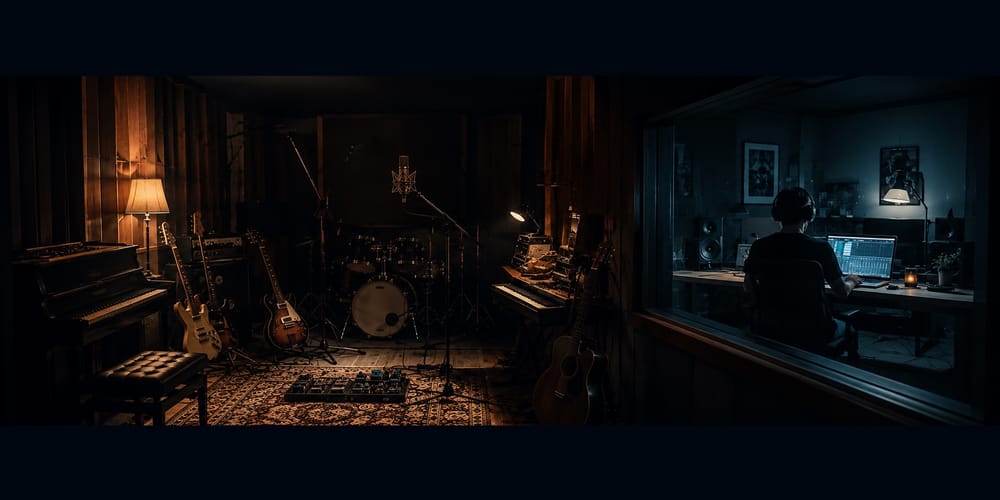
Not long ago, he brought that very piece to the same studio I’ve been using for decades.
He played the melody.
The sound engineer — also a mutual friend and colleague of ours — recorded it.
And then...
He sent the melody into AI-powered Suno. Or maybe some other program — doesn’t really matter.
The AI produced six or seven versions of that same melody in completely different styles.
Jazz.
Reggae.
Blues.
Symphonic rock...
Believe me — every version was brilliant.
Well, practically brilliant...
What happened next is hard to describe.
You really had to be there.
By the time we finished listening to the final version, it was frightening to look at my friend.
He was sitting there shaking with silent sobs.
Tears were streaming down his face.
The sound engineer and I tried to comfort him as best we could, asking what on earth had happened.
After some time, once he had calmed down a little, he finally managed to explain what had upset him so deeply that it had brought him to tears.
It turned out that he had written that melody many years ago.
And all those years he had dreamed of recording it properly in a studio, so that one day it might be heard at a concert, on the radio, or at least on the internet.
He had lived with that dream.
But somehow he had never managed to make it happen.
There was always something getting in the way.
Because to record that melody in even one — ONE!!! — stylistic version, he would have had to put together a band of like-minded musicians, find a rehearsal space, find a time when everyone could rehearse, rehearse the piece, arrange a studio session, find another time when everyone was available, record the composition, pay the studio...
And only then start thinking about how to get the finished result out into the world.
And what actually happened?
He came to the studio with his guitar.
Played the melody.
And literally half an hour later — HALF AN HOUR!!! — for free — FREE!!! — he had an entire musical album in which his melody existed in several completely different genres.
And sounded damn good in every one of them.
And he had practically had to do nothing to achieve it.
No assembling musicians.
No learning the craft of arranging.
No spending huge amounts of money...
He came.
He played.
He got the finished compositions.
He left.
And on the one hand, he was delighted with the result.
But on the other hand, he was upset because somehow it had all turned out to be just too...
easy, perhaps.
Too ordinary.
Thinking about this story, which happened literally just a few days ago, reminded me of an old joke.
There was once a tractor driver on a collective farm.
And this man had a dream: more than anything in the world, he wanted a brand-new Japanese tractor of his own. Let’s call it a “Mitsuwasaki”.
But he didn’t have the money for a tractor like that.
So he went around telling everyone how wonderful the “Mitsuwasaki” tractor was and how desperately he wanted one.
Basically, the man became completely obsessed with it.
Eventually his fellow villagers could no longer stand watching him suffer over this dream.
So they all chipped in, bought him a brand-new “Mitsuwasaki” for his birthday, drove it right up to his house and stood there waiting for him to come outside and lose his mind with happiness.
The man came out.
Looked at the tractor.
Looked at the villagers.
Waved his hand dismissively, turned around and went back inside.
The villagers couldn’t understand a thing.
“Hey! What’s wrong with you? This was your dream!”
And the man replied:
“Exactly. I had a dream. And you... killed it.”
That happens.
Personally, I have a dream too.
I would love to feed all of my several hundred songs into Suno and get reasonably decent arrangements that at least roughly match the way I imagine those songs should sound.
So that I could show them to people.
So what does that make me?
Does it mean I’m all for “AI forever”?!!
On the one hand — sure, I’m not against it.
But on the other hand, I keep reading in the media that the material used to train Suno — tens of millions of songs and musical compositions — was collected from all over the world in violation of copyright.
Roughly the same thing is now happening with printed books.
And since my songs are played on various national and other radio stations and are available online, it is entirely possible that some of my songs ended up in that giant AI meat grinder too.
And nobody — NOBODY!!! — asked for my permission as an author.
And nobody offered me any money for it.
If you look at the situation from that angle, does that mean AI is simply a thief?
An enemy?
But it helps me!
So does that make AI a friend?
As Vysotsky sang: “If a friend suddenly turns out to be neither friend nor foe, just... something in between... If you cannot tell at once whether he is good or bad...”
You can’t help feeling like Buridan’s ass.
I don’t want to end this article either with an artistically sorrowful expression on my face or with a cheerful optimistic smile.
Instead of an afterword
“And if there were no computers, no tablets, no smartphones — then there wouldn’t be any AI either, would there?
Neither good AI nor bad AI?...
Right?
Or not?...”
Stay Updated
New essays from After Login, about once every two weeks. New publications only. No promotional mail.
The Conversation Continues in the Lounge
The article ends here, but the conversation doesn’t. In the project Lounge, you can discuss what you’ve read, disagree with the author, reply to other readers, or start a topic of your own.
After Login, everything is just beginning.