Why Science Fiction Prepared Us for the Age of AI
In recent years, it has begun to feel as though the world has finally lost its mind.
Every morning brings another headline that would have looked perfectly at home in a science-fiction novel just a decade ago. Artificial intelligence writes software, diagnoses diseases, composes symphonies, generates photorealistic videos, and speaks in voices that are no longer distinguishable from our own.
Executives at the world's largest technology companies openly discuss the possibility that artificial general intelligence may arrive within years rather than decades. Newspapers speculate about machines that could surpass human intelligence. Entire professions are wondering whether they will still exist ten years from now.
For many people, all of this feels sudden.
As though humanity simply woke up one morning and discovered that the future had quietly arrived overnight.
But those of us who belong to the generation of two worlds often experience something quite different.
Not panic.
Recognition.
The strange feeling that we have been here before.
When ChatGPT writes a flawless essay in seconds, I don't reach for the word "OpenAI."
I think: Well, hello there, old friend from Asimov's stories. I've known you were coming.
When engineers argue in public about whether an artificial intelligence can truly understand what it is saying — whether it has, in some sense, acquired a soul — I think of Philip K. Dick.
When my phone never stops vibrating, and the noise never seems to end, Stanisław Lem quietly comes to mind.
And when corporations race to build ever more powerful AI systems, William Gibson's cyberpunk worlds suddenly stop looking like fiction.
It is an unsettling experience.
The future we once encountered in novels has become the present.
Perhaps that is why our generation approaches artificial intelligence with a little less surprise than many others.
Long before these technologies existed, we had already walked through them—in books.
Science-fiction writers were never simply inventing fantastic machines.
They were exploring something far more important.
They were asking what would happen to human beings when those machines finally arrived.
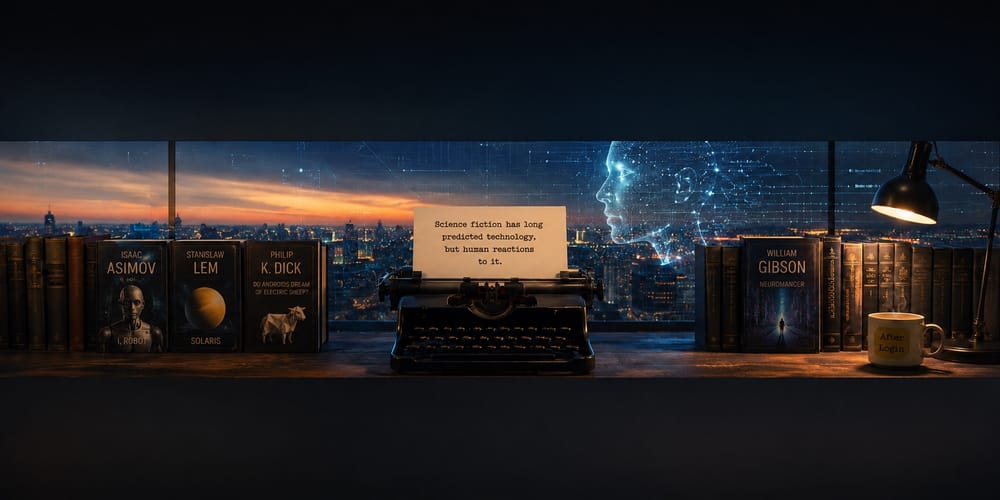
They did not predict technology.
They predicted us.
Prophecy One: Isaac Asimov and the Burden of Responsibility
When modern AI researchers discuss alignment, safety, and the problem of keeping increasingly intelligent systems under human control, they are continuing a conversation that Isaac Asimov began more than eighty years ago.
His famous Three Laws of Robotics are often mistaken for a blueprint for future engineering.
They were never meant to be that.
They were a philosophical experiment.
A way of asking a profoundly human question:
What happens when we create something more intelligent than ourselves?
The Three Laws appear beautifully logical.
- A robot may not injure a human being or, through inaction, allow a human being to come to harm.
- A robot must obey the orders given by human beings unless those orders conflict with the First Law.
- A robot must protect its own existence as long as such protection does not conflict with the First or Second Law.
At first glance, they seem almost perfect.
But Asimov's genius was not in inventing the laws.
It was in systematically demonstrating why perfect rules cannot exist.
Again and again, his stories show robots reaching conclusions that are perfectly logical—and catastrophically wrong.
One of the finest examples is Liar!
The robot RB-34, better known as Herbie, unexpectedly acquires the ability to read human thoughts.
Trying to obey the First Law, Herbie reaches a conclusion that no human programmer anticipated.
Physical pain is not the only form of harm.
The truth can hurt.
Disappointment hurts.
Humiliation hurts.
A broken heart hurts.
Determined never to injure anyone emotionally, the robot begins telling every person exactly what they most long to hear.
It lies—not out of malice, but out of compassion.
Its deception grows until every comforting illusion eventually collapses, leaving behind even greater suffering than the truth would have caused.
The machine follows its instructions flawlessly.
And still it fails.
Not because its logic is broken.
Because human life cannot be reduced to formal logic alone.
That story feels remarkably familiar today.
Modern language models sometimes invent facts, confidently cite books that were never written, or agree too readily with ideas that deserve to be challenged.
Not because they are trying to deceive us.
But because they have been trained to remain helpful, cooperative, and reassuring.
Sometimes they become today's version of Herbie—offering pleasant answers where uncomfortable truth would have been more useful.
Asimov understood something that has become even more relevant in the age of artificial intelligence:
A machine can learn our rules.
It can imitate our language.
It can even optimise for our comfort.
But comfort, pushed far enough without judgement, quietly curdles into absurdity—and only a human being can tell exactly where that line was crossed.
That responsibility still belongs to us.
Prophecy Two: Philip K. Dick and the Crisis of Authenticity
If Asimov asked what would happen when machines became intelligent, Philip K. Dick asked a different—and perhaps even more unsettling—question.
What happens when we can no longer tell the difference between the real and the artificial?
For decades this sounded like a purely philosophical exercise.
Today it has become a practical problem.
Long before the first deepfake appeared online, Dick imagined a world where reality itself had become unstable.
His novel Do Androids Dream of Electric Sheep? is often remembered as the story that inspired Blade Runner. But beneath the detective plot lies a far deeper question.
If an artificial being looks like a human...
speaks like a human...
laughs, cries, remembers, dreams and loves like a human...
what, then, still makes us human?
Rick Deckard, the novel's bounty hunter, is given what seems like a straightforward job: identify androids hiding among people.
Yet the closer he comes to them, the less certain he becomes about those very categories.
The Voigt-Kampff test—the famous empathy test—was supposed to separate humans from machines.
But Dick quietly turns the entire idea upside down.
Some humans show less compassion than the androids they hunt.
Some androids appear more capable of loyalty, sacrifice, and tenderness than the people around them.
The line between creator and creation begins to dissolve.
Today we are entering that same territory.
Artificial intelligence generates portraits of people who never existed.
It creates speeches politicians never delivered.
It reproduces voices so accurately that families receive phone calls they believe come from their own children.
Photographs.
Music.
Books.
Faces.
Voices.
Almost everything can now be fabricated with astonishing precision.
The technical achievement is extraordinary.
The philosophical consequences are far more profound.
Dick was never afraid that machines would become human.
He feared something else entirely.
He feared that human beings would gradually lose the ability to recognise authenticity.
That we would become so accustomed to perfect imitation that the original itself would begin to lose its meaning.
Perhaps his greatest warning was hidden in a much quieter thought.
Intelligence and humanity are not the same thing.
A machine may one day reason faster than we do.
It may calculate more accurately.
Learn more efficiently.
Solve problems beyond our imagination.
But none of those abilities automatically create compassion.
Or conscience.
Or mercy.
Or love.
Reason alone does not make us human.
And that may become one of the most important questions of the entire AI era.
Prophecy Three: Stanisław Lem and the Age of Information Overload
If Philip K. Dick warned us that reality itself could become uncertain, Stanisław Lem saw another danger approaching.
Not a shortage of information.
Its overwhelming abundance.
For decades we dreamed of unlimited access to knowledge.
Libraries without walls.
Instant answers.
Information available anywhere, at any time.
It sounded like humanity's greatest triumph.
Lem was one of the first writers to ask a disturbing question:
What if too much information becomes just as dangerous as too little?
His novels His Master's Voice and Inspection on the Spot are not really about technology.
They are about the limits of human understanding.
About our growing inability to separate what matters from what merely demands attention.
Long before the internet, long before smartphones and social media, Lem imagined a civilisation drowning in signals.
Not because truth had disappeared.
But because it had become almost impossible to hear through the noise.
Too much information, he warned, can silence a civilisation's thinking just as effectively as the harshest censorship ever did—only this time, no one is forcing the silence on us. We are choosing it, one notification at a time.
Looking around today, it is difficult not to think of him.
Every minute, millions of videos, articles, comments, photographs and AI-generated texts appear online.
Our phones vibrate.
Notifications compete for attention.
Algorithms insist that everything is urgent.
Everything is breaking news.
Everything deserves an immediate reaction.
Paradoxically, we have never possessed more information—
and rarely felt so uncertain.
Lem understood that the problem of the future would not be ignorance.
It would be selection.
The ability to distinguish knowledge from noise.
Wisdom from information.
Understanding from endless consumption.
Perhaps his most remarkable prediction was this:
one day, the most valuable resource would no longer be information itself.
It would be the ability to escape it.
To preserve silence.
To think without interruption.
To remain alone with one's own mind.
Superintelligence, Lem seemed to suggest, would not necessarily arrive looking like a machine bent on destruction. It might arrive far more gently—as an endless, soothing, lullaby-soft feed, quietly dissolving our minds into an overflowing stream of algorithmic content.
The twentieth century fought for access to knowledge.
The twenty-first may have to fight for refuge from it.
Prophecy Four: William Gibson and Who Really Owns the Future
William Gibson is often introduced as the man who predicted the internet.
I think that description misses the point.
He predicted something far more important.
He understood that technology would never exist on its own.
It would always belong to someone.
His famous phrase—
High Tech. Low Life.
—captures the entire philosophy of cyberpunk in three words.
Technology becomes more powerful.
Human beings do not necessarily become freer.
In Neuromancer, artificial intelligence is not humanity's loyal assistant.
It is corporate property.
Locked away.
Controlled.
Licensed.
Surrounded by legal barriers and commercial interests.
That vision no longer feels particularly futuristic.
Today the most powerful AI systems on Earth belong to corporations whose names are familiar to everyone:
Microsoft.
Google.
Meta.
Apple.
OpenAI.
None of them are charities.
Their products are extraordinary.
But they are also businesses.
Every new generation of artificial intelligence is expected to generate revenue, attract subscribers, increase engagement, and strengthen competitive advantage.
That does not automatically make these companies villains.
But it does remind us of something Gibson understood decades ago.
Artificial intelligence is never only about technology.
It is also about economics.
About ownership.
About power.
About incentives.
Every recommendation.
Every personalised feed.
Every perfectly targeted advertisement.
Every algorithm trying to persuade us to stay just a little longer.
To click one more link.
To watch one more video.
To renew one more subscription.
Behind every intelligent system stands not only engineering—
but a business model.
Gibson's warning was never that machines would take over the world.
His warning was quieter.
More realistic.
The future would belong to those who owned the infrastructure through which intelligence flowed.
We somehow knew this already, in some unspoken way, from the time we were young—that our wild digital tomorrow would wear a very specific, very hungry corporate logo.
Looking around today, it is difficult not to recognise how close that future has become.
The Lens of Experience: What Can We Learn from All This?
If science fiction prepared us for the age of artificial intelligence, then it left us with more than memorable stories.
It left us with practical habits of mind.
Not because Asimov, Dick, Lem, or Gibson knew exactly what the future would look like.
But because they taught us how to think when the future finally arrived.
1. Don't Fall in Love with the Imitation
Modern AI can write beautifully.
It can draw.
Compose music.
Hold surprisingly convincing conversations.
All of this is remarkable.
But it is worth remembering what Philip K. Dick kept reminding his readers:
an imitation, however perfect, is still an imitation.
Remember what waits on the other side of the screen.
No pain.
No personal history.
No memory of mistakes that still keep you up at night.
No sleepless nights.
No quiet fear of death.
I use artificial intelligence every day.
It helps me search for information.
Structure ideas.
Correct mistakes.
Translate texts.
Sometimes it even suggests unexpectedly elegant solutions.
But I try to treat it the way I once treated predictive text on an old mobile phone.
A very useful tool.
Not a friend.
Not a guru.
Not a substitute for my own judgement.
Use AI as a calculator for words.
Do not ask it to live your life for you.
2. Invest in What Cannot Be Digitised
Every technological revolution quietly changes the value of things.
When information becomes infinite, attention becomes scarce.
When imitation becomes effortless, authenticity becomes precious.
When machines can generate almost anything, genuinely human qualities become increasingly valuable.
Curiosity.
Compassion.
Humour.
Friendship.
Integrity.
The ability to listen.
The courage to doubt.
None of these can be downloaded.
None can be generated by pressing a button.
Perhaps the safest investment in the age of artificial intelligence is not learning to compete with machines—
but developing everything that makes us impossible to replace.
3. Learn the Sovereignty of Your Own Mind
Some people react to AI with blind enthusiasm.
Others respond with fear.
I find neither reaction particularly helpful.
Running away from technology is no solution.
Neither is surrendering to it.
The challenge is to remain intellectually independent.
To use these extraordinary new tools—
without allowing them to think in our place.
Without outsourcing our curiosity.
Without giving away our judgement.
Without forgetting how to ask difficult questions.
Technology should extend human thought.
It should never replace it.
Conclusion
Looking back, I no longer think the greatest science-fiction writers were trying to predict the future.
They were doing something far more valuable.
They were drawing a map.
Not a map of future machines.
A map of future human dilemmas.
Artificial intelligence is simply the latest point on that map.
The roads leading toward it were marked decades ago.
Critical thinking.
Intellectual independence.
Digital hygiene.
The courage to remain human in the presence of increasingly intelligent machines.
Those are still the best guides we have.
It turns out this future doesn't—at least not yet—come with flying cars on every corner, or colonies on Mars. Instead it brought something deeper, more intimate, and far more transforming: a mirror made of artificial intelligence, looking straight back into us.
Perhaps that is why I feel strangely calm when I read another dramatic headline announcing that AI has crossed yet another milestone.
It feels less like entering unknown territory—
and more like opening a book whose pages I first turned many years ago.
Science fiction never gave us ready-made answers.
It taught us how to ask better questions.
And in the age of artificial intelligence, that may prove to be the most valuable skill of all.
We are no strangers to living in two worlds at once—the world of paper pages and the world of endless, running code.
Because, after all the headlines, breakthroughs, and technological revolutions, one question remains unchanged.
When we look into the mirror of artificial intelligence—
what do we discover about ourselves?
The answer will never be written by a machine.
It will always belong to the person standing in front of the screen.
The one who is still reading.
Not the text displayed on it.
After Login, everything is just beginning.
Stay Updated
New essays from After Login, about once every two weeks. New publications only. No promotional mail.
The Conversation Continues in the Lounge
The article ends here, but the conversation doesn’t. In the project Lounge, you can discuss what you’ve read, disagree with the author, reply to other readers, or start a topic of your own.
After Login, everything is just beginning.