When Closed Doors Become Unexpected Teachers
If someone had told me ten years ago that I would one day be renting servers in Dutch or German data centers, configuring DNS records, setting up encryption, and discussing internet traffic routing with a straight face, I would have laughed out loud.
First, I was never a programmer. My relationship with complex code always ended at the level of “turn it off and on again.”
Second, I never worked in IT. My youth belonged to the world of tangible things — paper books, vinyl records, cassette decks — where the most complicated breakdown was rewinding a chewed tape with a pencil.
And to be honest, I never had much interest in the inner workings of the internet. For me, the internet was simply a convenient urban utility — like central heating or electricity. We don’t think every day about how a turbine works at a hydroelectric plant. We just turn the tap — and hot water flows. We flip a switch — and the room lights up.
The internet was exactly the same. Open the laptop, click the browser icon, find the article you need, watch a concert video, send a message to a friend. Everything spun and worked quietly, invisibly, flawlessly. And that “black‑box magic” was more than enough for me.
But then our quiet digital paradise began to change. And it didn’t start with internal restrictions — it started with the world around us slamming its doors shut.
Later I realized this was part of a much larger global process. It was simply more visible — and more painful — where we lived.
Across the world, the internet is slowly ceasing to be a single open space. Europe debates platform regulation and content control. The U.S. argues about censorship and algorithmic power. The U.K. introduces age‑verification systems. Even countries once considered symbols of digital freedom now let governments and corporations decide what users can see, buy, download, or even say.
Once, the internet felt like a boundless ocean. Today it is increasingly divided into fenced‑off territories with their own laws.
In our case, these changes became visible not in news headlines — but directly on our screens.
One day, the familiar world behind the screen simply began to evaporate.
One by one, global services began leaving the country. Music disappeared first — Spotify turned into a pumpkin overnight, leaving years of carefully built playlists behind. Then global cloud storage waved goodbye, carrying away years of accumulated files. And the final blow came with the rise of artificial intelligence: while the world discussed the revolution of neural networks, ChatGPT and the leading AI assistants simply closed their doors to us, one geographic border at a time.
They tried to cut us off from the future by locking us inside a technological past.
And just as we began to grasp the scale of this external exodus, the second wall went up — internal blocks. A double fence grew around us.
A favorite foreign blog suddenly loaded for five minutes, as if through a squealing modem from the nineties. Images stopped appearing on some sites. Comments broke. Login buttons vanished. The era of digital abundance was replaced by an era of mute walls and “Access restricted” signs.
And a short word, sharp as a gunshot, entered our vocabulary: VPN.
At first it felt like a spy game. Download a free app with a blue rabbit or a shield. Tap the big round button. One second — the rabbit runs, the fence melts. Life goes on.
But the rabbit didn’t run for long. One day the button spun and spun — and nothing happened. The rabbit died.
I installed another app — with a bear. A month later, the bear stopped working too. Then a third, a fourth, a tenth… My phone screen turned into a graveyard of free utilities that promised “fast and eternal access” but died faster than I could finish my morning coffee.
At some point, desperately switching between apps just to launch a chatbot for work or read morning analytics, I felt something sharp and unpleasant.
I’ve always struggled with situations where I depend completely on a tool whose inner workings I don’t understand. Sitting helplessly in front of a screen, waiting for some free service to “descend” to me — it felt humiliating.
That was the moment when passive grumbling turned into stubborn curiosity.
External sanctions and internal restrictions created a perfect storm. There was no choice left.
A journey began — into a world I had always assumed belonged to pale young men in oversized hoodies who spoke a language no normal person understood.
First, I discovered that all these “VPNs” were very different. A parade of names and abbreviations appeared: OpenVPN, WireGuard, Amnezia, VLESS, Reality… Each one sounded like a combat robot from a Philip K. Dick novel.
At first my head spun. But once the panic faded, behind the terms I found logical — even elegant — engineering ideas. It wasn’t magic. It was math, encryption, and disguise.
Then came another, sobering realization: almost all popular VPN services run on someone else's servers. If that server belongs to, say, Singapore, I inherit all its risks. Tomorrow the owner may triple the price, leak logs to advertisers, or get blocked just like everything else.
That’s when a three‑letter word entered my life: VPS — Virtual Private Server.
Put simply: your own tiny piece of a computer, standing in a sterile hall of an Amsterdam data center, plugged into a socket, hiding behind no curtain, working 24/7, obeying only your commands.
Let’s be honest: for someone far from IT, renting a server in Europe felt like pure madness. Why would an ordinary person need this? Isn’t this a toy for corporate sysadmins?
But the curiosity was unstoppable. Maybe it was the same stubbornness with which we once built homemade radios in dorm rooms to catch Seva Novgorodsev through the jammers.
I shut my eyes tight, entered my card details, and rented my first VPS. Just a few euros a month.
And that’s when the real university began.
Behind the black console screen, where a lonely white cursor blinked, a whole universe opened.
I remembered that every device on the network has a passport — an IP address. I learned what SSH keys are — when your server lets you in not by a silly password, but by recognizing your computer like an old friend. I figured out how DNS servers work — the phone books of the internet — and how a domain name links to a string of numbers. I met Cloudflare, the guardian against storms, and understood why SSL certificates sit proudly as padlocks in the address bar.
And of course, I learned the main law of IT the hard way: “There are two kinds of people — those who don’t make backups yet, and those who already do.”
This happened when one wrong command turned my server into a pumpkin, and I spent half the night resurrecting it piece by piece, cursing quietly under the glow of a night lamp.
Sometimes it was thrilling as hell. Sometimes it was infuriating enough to make my teeth itch. Sometimes, when the code stubbornly returned "Error 403" or "Connection refused," I wanted to slam the laptop shut and go plant potatoes at the dacha.
But step by step, something remarkable happened.
My inner position changed.
I stopped being a faceless “user,” pushed around by algorithms, sanctions, and blocks like a ping‑pong ball. I began to understand how this giant nervous system of the modern world works.
And the most valuable result of this year‑long marathon? Not fast access to music, or to an AI no regulator can take away from me now. Not even the mountain of new knowledge.
But the forgotten feeling of control. The return of sovereignty over my own mind.
Now, when something breaks online, I don’t panic. I don’t click “Refresh” with tears in my eyes. I calmly open the terminal, check the traffic routes, and at least understand where the crack lies.
This thorny path is what gave birth to my blog After Login. First came the server. Then the domain. Then email on my own platform. Independent analytics. I built my own small, sovereign, cozy digital home — with no ads, no clickbait, no algorithms trying to steal my attention.
The irony is that I never wanted to become an IT person. I had no passion for technology for its own sake. It all began with a simple, deeply human desire: to preserve my access to culture, knowledge, and the vast world that was suddenly being wrapped in barbed wire before my own eyes.
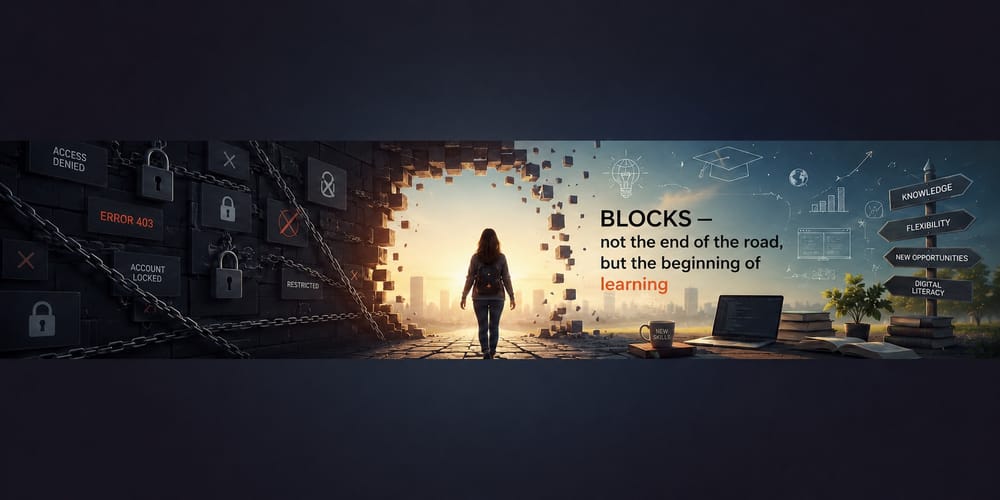
People say restrictions close doors. My experience showed the opposite.
Yes, the front doors slammed shut. But instead of sitting in the dark hallway, I looked up — and found a window, a fire escape, a hidden passage to the roof where the stars were visible.
External and internal pressure forced me to turn on my brain and learn a massive layer of knowledge I would have happily ignored in calmer, well‑fed times.
So, paradoxically, I’m grateful for this “double fence.” Without it, I would have remained a lazy consumer of digital fast food.
No one enrolled me in this university of digital awareness — life did. And I don't regret a single one of those exam sessions.
Because the wisest lesson of this unexpected education turned out to be simple — and not technical at all:
Lack of knowledge or a missing diploma stops us only in the tiny moment when we sigh and say: “I’m too old for this. I’ll manage without it. I don’t need it anymore.”
That is the moment learning ends — and decay begins.
Everything else is just another unfamiliar five‑letter word that, with enough persistence, becomes clear, familiar, and obedient.
And how did you survive the digital storms of recent years? Did the “double fence” push you to learn something new — or are you still searching for that perfect “bear” in the app store?
Share your stories below — let’s remember how we learned to survive after the login.
After Login, everything is just beginning.
Stay Updated
New essays from After Login, about once every two weeks. New publications only. No promotional mail.
The Conversation Continues in the Lounge
The article ends here, but the conversation doesn’t. In the project Lounge, you can discuss what you’ve read, disagree with the author, reply to other readers, or start a topic of your own.
After Login, everything is just beginning.