When Buying No Longer Means Owning
A Quiet Revolution in Digital Capitalism
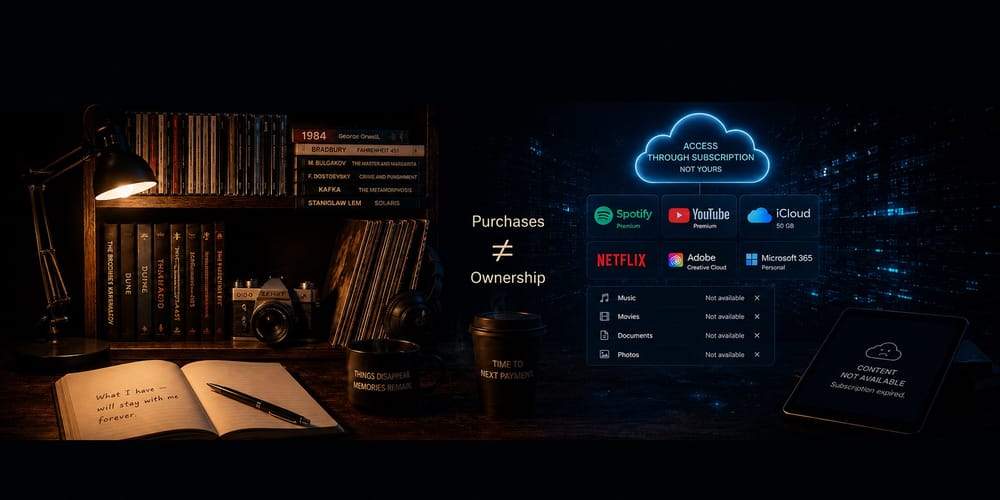
Do you remember the quiet pleasure of buying a book or a CD?
You brought it home, placed it on a shelf, and it became yours.
Forever.
You could lend it to a friend, give it away, sell it at a flea market, or leave it to your children. A book could gather dust, its pages could turn yellow, but no one could come into your home in the middle of the night and remove it from your shelf simply because a publisher’s licence had expired.
In the digital world, this is already happening.
While you sleep.
Without quite noticing it, we have crossed a line beyond which the familiar idea of ownership has been dismantled.
We still click buttons labelled Buy.
We still pay real money.
But we no longer truly buy anything.
We are taking the world on a long, expensive lease — while still being allowed to feel like owners.
The Illusion of Ownership
In 2009, something happened that is now studied in law schools as a symbol of a new era.
Owners of Amazon Kindle e-readers discovered that books they had legally purchased had mysteriously disappeared from their devices. Amazon had remotely deleted the files without warning.
The irony was almost too perfect.
One of the deleted books was George Orwell’s 1984 — perhaps the most famous novel ever written about censorship, surveillance, and the rewriting of the past.
Amazon had run into licensing problems with that particular edition and solved the matter with a click.
At the time, it seemed outrageous and caused a scandal.
Today, it has become an industry standard.
- Films and television. In 2023, Sony announced that it would remove hundreds of purchased Discovery titles from PlayStation users’ libraries. People had paid for those films and shows. Then the content simply vanished because Sony’s licensing agreement had expired.
- Games. In spring 2024, Ubisoft shut down the servers for The Crew. But the company did not merely close the online service. It revoked players’ licences. The game disappeared from personal libraries and could no longer be launched, even in single-player mode. Paid $60 at release? Sorry. Your time has expired.
- Software. We can no longer buy Photoshop or Microsoft Office once and keep using them for as long as our computer can run them. We have been hooked on the subscription drip. The moment your money runs out — or the payment system in your region falls under sanctions — a working tool can turn back into a pumpkin.
The modern EULA — the licence agreement almost none of us read before ticking the box — says, in legal language: you are not paying for a thing. You are paying for temporary permission to use it for as long as it remains profitable for us.
Subscription Cars and Locked Seats
If you think this problem applies only to pixels on a screen, I have bad news.
Digital capitalism is already devouring the physical world.
The logic of subscriptions and remote control is moving into objects we can touch with our hands.
A few years ago, BMW shocked drivers by introducing a subscription for... heated seats.
The heating elements were physically installed in the car. You had already paid for them when you bought the vehicle. The hardware was already there. But the feature was locked by software.
Want warmth in winter?
Pay $18 a month.
Stop paying, and the algorithm refuses to send power to your seat.
John Deere, the maker of smart agricultural machinery, has spent years preventing farmers from repairing their own tractors.
If a minor part breaks, a farmer cannot simply replace it and keep working. The onboard computer blocks the engine until a certified technician arrives with proprietary software and approves the repair through the company’s system.
Farmers who have paid hundreds of thousands of dollars for a machine legally do not have the right to repair it.
We are quietly turning from owners into users with temporary access.
Why Is This Dangerous for Us as a Civilisation?
For those of us who grew up in the analog world, this shift creates a deep sense of unease.
And it is not simply about lost money.
The problem goes much deeper.
1. The Erasure of Cultural Memory
When culture becomes entirely digital and dependent on streaming platforms, it becomes frighteningly easy to edit.
Older films are re-dubbed.
Scenes from television series made decades ago are removed because they no longer fit today’s standards.
Paragraphs are changed in e-books.
If we no longer own physical media — books, vinyl records, CDs, Blu-ray discs — we lose proof of what a work originally looked like.
The past becomes plastic.
2. The Death of Privacy
For a corporation to verify that you still have permission to listen to a song, watch a film, or switch on your heated seats, your device must constantly inform on you to a server.
Physical ownership guaranteed privacy.
Nobody knew which book you were reading beneath the blanket with a flashlight.
Digital “ownership” requires total, continuous supervision.
3. The Loss of the Right to Be Frugal
The analog world had a beautiful ecosystem built around ownership.
Second-hand shops.
Used bookstores.
Libraries.
Flea markets.
Hand-me-downs.
Family collections passed from one generation to the next.
This allowed people with little money to survive — and it preserved history.
A digital copy of a game or book cannot be sold at a flea market or passed on to someone else.
It dies with your account.
Ownership is quietly replaced by access.
And access always expires.
How Do We Preserve Freedom in the Age of Temporary Access?
I am not suggesting that we throw away our smartphones or fill the basement with canned food and floppy disks.
But as someone who has lived in both worlds, one thing is obvious to me: we must change our digital habits before we finally lose the right to choose.
So what can we do — after login?
- Support physical media. If there are books, albums, or films that truly matter to you, buy them on paper or disc. Build a small “golden collection” at home that physically belongs to you and that no server can erase.
- Vote with your wallet against subscription madness. Whenever there is a choice between buying software once — especially DRM-free — and paying for a subscription, choose ownership. Support platforms such as GOG, where games are sold without digital protection and remain with you as files, instead of platforms that can ban your account at any moment.
- Create local backups. Keep important data — photographs, family archives, documents — not only in clouds owned by Google or Apple, but also on physical drives you control.
- Do not put your entire life into one ecosystem. When all your photos live only in iCloud, all your messages in one messenger, and all your documents in one cloud, you become completely dependent on the decisions of a single company. Any account block, technical failure, or change of rules can become a personal disaster.
- Use formats you can take with you. A text file, PDF, MP3, JPEG, or EPUB can be opened on almost any device. Closed platform formats tie you to a specific service. The easier it is to move your data from one system to another, the more freedom you retain.
- Buy not only content, but skills. A subscription can be cancelled. A service can shut down. An account can be blocked. But knowledge, experience, and the ability to do something with your own hands remain with you. The safest asset in the digital age is not a file stored on a server. It is a skill stored in your own mind.
- Build your own digital home. Social networks are rented apartments. Today the algorithm shows your writing to people; tomorrow it stops. Today the platform exists; tomorrow it is bought, closed, or changed beyond recognition. If you truly have something to say to the world, create a place that belongs to you: your own website, blog, or archive.
- Preserve the right to disconnect. The least visible dependency is not on content, but on constant connection. Not every object needs the internet. Not every device must verify your licence with a remote server. Not every evening has to be governed by recommendation algorithms. Sometimes freedom begins with the ability to press Off.
Perhaps freedom in the twenty-first century will not be measured by how many things a person owns.
But by how many things, data, memories, and skills remain truly theirs even after the internet is switched off.
For too long, we treated digital convenience as a free bonus added to life.
We are beginning to discover that it was never free.
We have been paying with ownership.
With privacy.
With independence.
Digital independence begins with alternatives.
With a copy of your family archive on a drive at home.
With a book on your shelf.
With a website that belongs to you.
With the ability to live without the next service if it disappears one day.
The right to own is one of the pillars of human freedom.
And if we willingly exchange it for convenience and a beautiful Streaming button, we may one day discover that, in the digital world, it is no longer only our music, films, or books that do not belong to us.
Not even our own history belongs to us.
Stay Updated
New essays from After Login, about once every two weeks. New publications only. No promotional mail.
The Conversation Continues in the Lounge
The article ends here, but the conversation doesn’t. In the project Lounge, you can discuss what you’ve read, disagree with the author, reply to other readers, or start a topic of your own.
After Login, everything is just beginning.