★We Are the Generation of Two Worlds
🎧 Now articles can not only be read, but also listened to.
🎬 You can also watch and listen to this essay on YouTube.
Every generation has a moment when the world quietly becomes something else.
For ours, it sounded like a dial-up modem.
I can still remember it with surprising clarity—not as an idea, but as a physical memory.
It smelled of warm plastic, dust, ozone, and the heated glass of an old CRT monitor. It smelled, somehow, of home.
I remember sitting alone in a dimly lit room, staring at the deep black screen of DOS, broken only by glowing green command lines. The computer took its time waking up, grumbling and rattling like an old giant reluctant to leave its sleep.
And then it came.
That sound.
Anyone who heard it remembers it.
No modern technology has managed to erase it from our memory.
First came the dull clicks of the telephone line.
Then a piercing electronic whistle.
Then the modem erupted into its furious chorus of hisses, screeches, and metallic static—as though two distant spacecraft were desperately trying to find one another through a storm of cosmic interference.
A few long seconds later, silence returned.
Then a single word appeared in the corner of the screen.
Connected.
It looked so ordinary.
Yet in that very moment, something extraordinary happened.
Into an ordinary room—with books on the shelves, paper wallpaper on the walls, and the familiar sounds of the courtyard outside—an unknown ocean quietly began to flow.
We had no idea how vast it was.
We knew nothing about its currents.
Nothing about its storms.
We were simply delighted that a grainy image, barely three hundred pixels wide, had loaded in only three long minutes.
Looking back now, I realise that none of us understood what had just happened.
We thought we had connected to the internet.
In reality, we had connected to the future.
And the future was about to change almost everything.
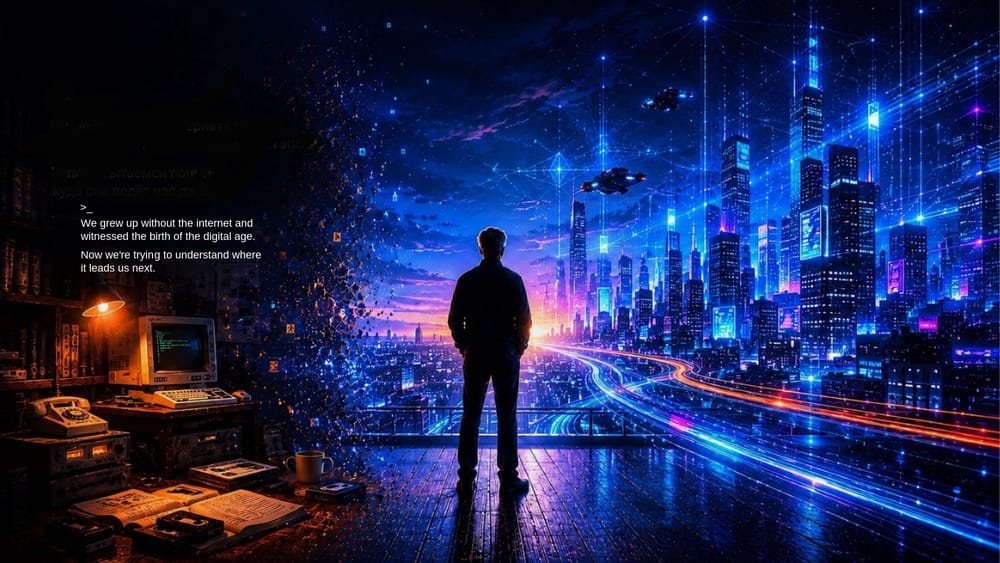
We are the last generation that remembers a world without the internet.
At the same time, we are the first generation that had to grow up inside it, build our lives inside it, and now learn how not to lose ourselves within it.
Part I. The Warm Continent
Before ruthless algorithms overwrite these memories completely, let us preserve them for a little while longer.
What was life actually like before the world became one vast digital network?
It was a world made of tangible things.
Information had weight.
Volume.
Texture.
It did not float somewhere in an invisible cloud waiting to appear with a click.
You had to go looking for it.
Some of my strongest memories begin on the narrow balcony of our fifth-floor apartment.
On warm summer nights I would lie on a folding bed with a heavy VEF-12 radio pressed against my ear, slowly turning the stiff tuning dial, searching through waves of static for the BBC or Voice of America.
Behind the crackle of interference, Seva Novgorodsev would spend what felt like hours talking about new albums by Pink Floyd, Led Zeppelin, or Black Sabbath.
It felt less like listening to a radio programme than discovering forbidden knowledge.
Owning music required an entirely different ritual.
You got dressed.
Crossed the city.
Made your way to the legendary Gorbushka market—or one of the few semi-legal record shops.
You stood in line.
Finally held the cassette or vinyl record in your hands.
Then you carried it home like treasure.
There was no Skip Track button waiting to rescue your attention.
You listened to the album from beginning to end, slowly entering the musicians' world while studying the tiny booklet with its blurred photographs and fresh printing ink.
Music was not background noise.
It was an event.
And every event demanded the most valuable thing a person possesses.
Time.
Daily life followed the same rhythm.
If your mother needed a recipe for a holiday cake, she didn't open a search engine and drown beneath thousands of identical websites.
She walked to the family bookcase, took down a heavy cookbook—or opened an old handwritten notebook where your grandmother had carefully collected recipes over the years.
Knowledge had handwriting. It had history. And it had value.
Even the telephone shaped the way we lived.
It was fixed to the wall by a thick coiled cord.
The length of that cord defined the limits of your privacy — exactly two metres from the wall socket, not an inch more.
If you wanted to meet a friend, you couldn't send a quick message saying, "I'm on my way."
You simply walked into the courtyard and shouted their name beneath the windows.
Strangely enough, people still found each other.
Without GPS. Without endless rescheduling. Without apologising for the third postponed meeting because someone was "buried in deadlines."
A promise was usually enough.
And certainty was simply part of everyday life.
Perhaps the greatest luxury of the analog world was something we hardly appreciated at the time.
It was boredom.
When there was absolutely nothing to do, you didn't disappear into an endless stream of short videos.
You stayed alone with your own thoughts.
You might spend an hour watching raindrops slide down a window.
Studying the intricate patterns in a carpet.
Reading the ingredients on the back of a random bottle simply because nothing else demanded your attention.
Out of that quiet boredom came imagination.
Out of it came depth.
Our attention belonged entirely to us.
It wasn't measured, analysed, packaged, or sold.
We were still the rightful owners of our inner silence.
Part II. The Digital Paleozoic
Then came the 1990s and the early years of the new century.
Looking back, I sometimes think of that era as the Digital Paleozoic—a time when an entirely new civilization was still taking shape, and we had the strange privilege of building parts of it with our own hands.
Everything felt experimental.
Nothing was polished.
Nothing was guaranteed.
That was precisely what made it so exciting.
Do you remember the first computer clubs?
Most of them were hidden away in basements with poor ventilation, filled with the smell of cheap coffee, energy drinks, cigarette smoke, and the electric hum of overheated computers.
Somewhere between endless games of Counter-Strike and Quake, an entirely new social world was quietly coming into existence.
Or those awkward mobile-rack caddies we used to carry hard drives from one computer to another.
A friend would lend you a drive for an evening so you could copy two DivX movies that had taken someone days to download.
At the time, it felt perfectly ordinary.
Today it feels almost archaeological.
The first websites were hardly beautiful.
Flashing GIFs.
Bright colours.
Unreadable fonts.
Layouts that ignored every rule of modern design.
And yet they were alive.
They carried the unmistakable feeling that ordinary people—not corporations—were building this new world.
The internet of those years resembled the Wild West.
There were very few rules.
No dominant platforms.
No recommendation engines shaping every decision.
Governments had barely noticed it.
Large corporations had not yet fenced it off. It felt enormous.
Untamed.
Open—a vast space of unguarded human honesty and unembarrassed geek romanticism.
We hid behind strange usernames.
Argued on internet forums until four in the morning.
Spent hours downloading music through Napster, eMule, and countless forgotten peer-to-peer networks.
But what I remember most is not the technology.
It was the optimism.
We genuinely believed the internet would make humanity wiser.
We believed that giving everyone free access to the world's accumulated knowledge would spark a new Age of Enlightenment.
We believed lies would become impossible because every fact could be checked in seconds.
Looking back now, those hopes seem almost painfully innocent.
And yet I would never laugh at them.
Because, for a brief moment in history, many of us truly believed that technology would help people become better versions of themselves.
Perhaps that belief was naïve.
But it was also deeply human.
And, in its own way, rather beautiful.
Part III. When the Algorithms Took Over
The transformation didn't happen overnight.
That may be why so few of us noticed it.
The open ocean we had once entered with such excitement gradually became something very different.
Not a space of freedom, but an ecosystem governed by commercial algorithms.
Today, information is no longer scarce.
It has become overwhelming.
We no longer search for knowledge.
Knowledge searches for us.
It follows us from one screen to the next, pushing its way into our lives through endless streams of Shorts, Reels, TikToks, notifications, recommendations, and carefully personalised feeds.
Modern attention algorithms are among the most sophisticated systems humanity has ever built.
Behind them stand behavioural scientists, psychologists, neuroscientists, data engineers, and some of the largest technology companies in history.
Together, they study one thing with extraordinary precision:
How to keep us looking at the screen for just a little longer.
These systems know astonishing amounts about us.
What captures our attention.
What frightens us.
What makes us angry.
What keeps us scrolling.
Sometimes it feels as though they understand our minds better than our own mothers ever did.
And they are not designed to maximise our happiness.
They are designed to maximise our attention.
Because attention has become one of the most valuable commodities in the modern economy.
The longer we stay, the more profitable we become.
The internet is no longer the quiet, safe place many of us first discovered.
It has become a zone of permanent mental warfare—a Hobbesian war of all against all, fought one notification, one recommendation, one suggested video at a time, for the same limited resource: our ability to think without interruption.
Generative artificial intelligence has made this transformation even more profound.
Today, machines can produce endless streams of flawless text, photorealistic images, convincing voices, and videos that are almost impossible to distinguish from reality.
The boundary between truth and fabrication has not simply become blurred.
In many situations, it has almost disappeared.
But perhaps the most significant change has been economic rather than technological.
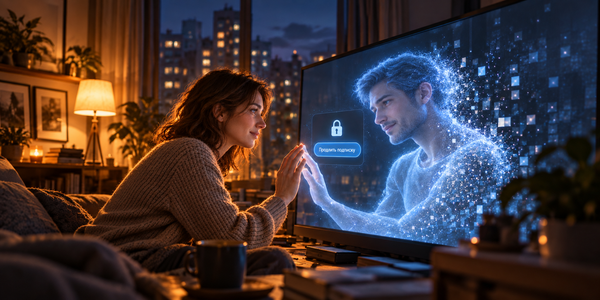
Somewhere along the way, we quietly stopped owning the things we believed we had bought.
Subscriptions taught us to value convenience above ownership.
Today, when we click Buy beneath a digital book, an album, or a film, we often purchase nothing more than a temporary licence.
A corporation can change its policies.
Withdraw a licence.
Deactivate an account.
Press a single button.
And something we believed belonged to us simply vanishes.
Without warning.
Without negotiation.
Without appeal.
We have gradually become tenants in a digital world we once imagined we would own.
Part IV. Between Two Eras
Our generation stands where two eras meet.
Behind us lies an analog childhood—a world where we learned to make friends without social networks, read long novels without distraction, and stay focused on a single thought for longer than fifteen seconds.
Ahead of us stretches a digital future shaped by artificial intelligence, synthetic media, virtual worlds, and technologies that are evolving faster than our ability to understand their consequences.
We belong to both worlds.
And that is both our burden and our advantage.
Generation Alpha was born into the digital age.
For them, a touchscreen is as natural as a light switch.
They are not losing a world they once knew, because they have never known a different one.
Many older generations spent most of their lives before digital technology transformed everyday existence.
They can choose to remain observers.
But those of us whose youth began with the screech of a modem and the black screen of DOS have never had that luxury.
We have had to learn two completely different ways of living.
Two ways of communicating.
Two ways of learning.
Two ways of understanding reality itself.
We are the living bridge between the warm glow of the analog world and the silicon horizon of the future.
That is our challenge.
But it is also our greatest strength.
We are not easily dazzled by perfect interfaces because we remember a world without them.
We know the weight of a printed page.
The comfort of silence.
The depth of an uninterrupted conversation.
We know that convenience is not always the same thing as freedom.
Perhaps that is why our generation still has something important to contribute.
We remember life before algorithms.
We now live among them.
We understand both languages.
And perhaps it falls to us to remind those who come after us of something surprisingly easy to forget:
Technology is one of the greatest achievements of human civilisation.
But it must always remain a tool.
It should expand what it means to be human—
never replace it.
Every generation inherits a different world.
Ours inherited two.
And perhaps that is exactly why our story is worth telling.
Because after we log in, the conversation has only just begun.
Stay Updated
New essays from After Login, about once every two weeks. New publications only. No promotional mail.
The Conversation Continues in the Lounge
The article ends here, but the conversation doesn’t. In the project Lounge, you can discuss what you’ve read, disagree with the author, reply to other readers, or start a topic of your own.
After Login, everything is just beginning.