The Music We Once Had to Search For
When I get into my car today, all I have to do is say a few words:
"Play Led Zeppelin."
Or tap a single button on my phone before setting off.
A fraction of a second later, Jimmy Page's guitar comes alive through the speakers — perfectly clean, flawlessly digitised.
The entire musical archive of humanity — millions of albums, terabytes of sound created over centuries — now lives inside a single streaming app on my phone.
It is nothing short of a technological miracle.
So why, when I listen to that flawless sound in perfect quality, do I sometimes catch myself feeling a strange, faint phantom ache?
Music has surrounded me since childhood.
It has walked beside me all my life, filling pauses, saving me in moments of heavy thought, sharing joy and silence with me. Home, work, endless kilometres behind the wheel — everywhere, there has always been its own soundtrack.
But lately I keep returning to one persistent thought.
In a world where music has become available with a single click, we have gained extraordinary convenience.
And yet...
we have lost something very important forever.
To understand what that is, I need to go back half a century.
To a world where music had to be searched for.
A world where music was not background noise, but an event, an act, and a genuine scarce treasure.
Chapter One. The Fifth-Floor Balcony and the Wandering Airwaves
If I close my eyes, I can still remember that warm southern summer night from my childhood in astonishing detail.
The fifth floor of my childhood home.
An uncomfortable, creaking canvas folding bed placed out on the balcony to escape the heat trapped inside the apartment during the day.
A dark sky overhead.
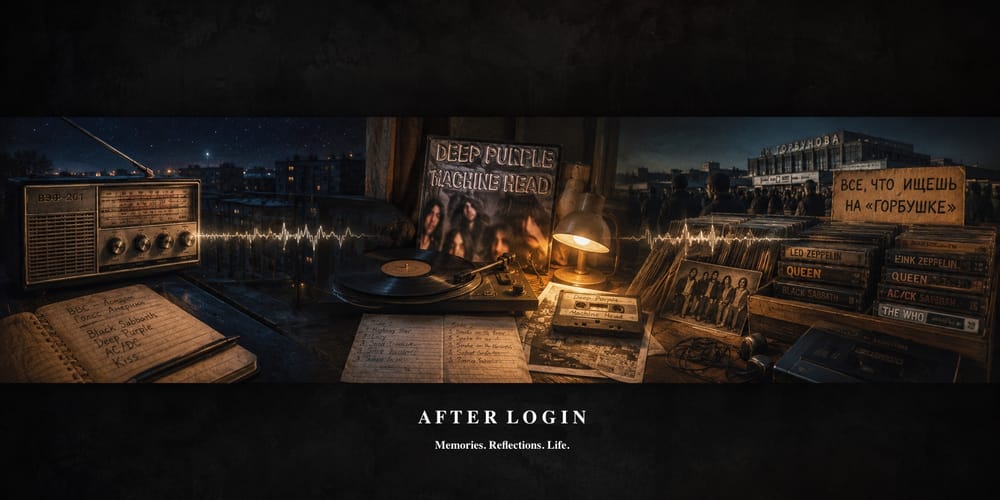
And the main artefact of that time: a VEF-201 radio receiver pressed tightly to my ear so I would not wake my parents.
In those years, Soviet radio was sterile and predictable.
But at night, when the world grew quiet, another reality broke through the crackle, whistles, and dull monotonous hum of the jammers.
It was the magic of shortwave radio.
I remember holding my breath, my fingers frozen on the tuning wheel, catching the slipping signal millimetre by millimetre.
Through the cosmic static, a distant voice would suddenly break through, unlike anything else in the world:
"Seva Novgorodtsev, London, BBC..."
Or the call signs of Voice of America.
This was not simply listening to the radio.
It was an act of mental smuggling.
An adventure.
The signal drifted, faded, drowned in an ocean of interference. You had to strain your ears and listen into every rustle.
And it was there, on that balcony, through the Iron Curtain and the jammers, that they first burst into my life.
The heavy, almost shamanic rhythm of Black Sabbath.
Ian Gillan's piercing voice in Deep Purple, powerful enough to knock the breath out of you.
The electrified, clean energy of AC/DC.
And the theatrical drive of Kiss.
It was not simply different music.
It was music from another planet.
It smelled of freedom, distant countries, and something unimaginably vast.
You fell asleep to the crackle of that radio with the feeling that you had touched a secret most people around you did not even suspect existed.
Chapter Two. The Ritual Under the Night Lamp
Later, when we grew a little older, music demanded material form.
First came reel-to-reel tape recorders.
Then cassette decks.
But the true Holy Grail was vinyl.
It is almost impossible to explain to a young person today what it meant to "get hold of" a record.
Records were not sold in ordinary shops at all.
They were bought from black-market dealers, sometimes for half — or even an entire — monthly salary of an engineer.
It was an enormous financial risk.
And at the same time, a pass into a closed club.
I remember those winter evenings.
Three or four close friends would gather at someone's home.
On the table, only one old night lamp would be burning.
The host, with quiet reverence, barely breathing, would take the record out of its cardboard sleeve.
It was a whole ritual.
You held it carefully only by the edges, careful never to let a fingerprint touch the grooves.
You lowered the needle.
Then came that first, incomparable soft click — and the quiet hiss of vinyl before the opening chords.
And we sat in silence.
No one talked.
No one was distracted by a phone.
There were no phones.
We did not listen to music "in the background" while frying eggs or checking email.
We practised pure contemplation of sound.
Every album was studied like a great work of art.
We spent hours looking at the cover: trying to read unfamiliar English words, studying photographs of the musicians, absorbing every detail of the design.
If someone lent you a record for just one night so you could copy it onto cassette, that night became sleepless.
We copied it carefully.
Then, by hand, in the neatest handwriting we could manage, we filled in the cassette insert:
Track 1, Track 2...
It was also around that time that the guitar entered my life.
We were desperately short of information.
There were no YouTube lessons.
No tabs on the internet.
By ear, moving the needle back again and again or rewinding a cassette with a pencil a hundred times, we tried to pick out those guitar rhythms.
Our fingers were rubbed bloody against the hard strings of Soviet acoustic guitars.
But when something suddenly came out from under your hands that sounded even remotely like the opening of Stairway to Heaven, you felt like a demigod.
Chapter Three. Gorbushka as a Place of Power
And then, in my life — as in the lives of thousands of like-minded people — Gorbushka appeared.
The legendary patch of ground near the Gorbunov House of Culture.
In the 1990s, it became a true Mecca for everyone in whose veins rock and roll flowed instead of blood.
A trip to Gorbushka was a pilgrimage.
It did not matter whether it was freezing outside, pouring with rain, or ankle-deep in slush.
You travelled across the entire city, clutching your saved-up roubles in your pocket.
The atmosphere there was charged with passion.
Thousands of people moved between the rows, sorting through plastic boxes of CDs and cassettes, arguing about alternative versions of albums, exchanging news.
There were no recommendation algorithms.
The recommendation was a living person on the other side of the counter — another mad music lover just like you, who could say:
"Listen, a new Gillan bootleg has appeared. The recording is rough, straight from the mixing desk, but the performance is insane. Take it. You won't regret it."
And you took it.
Then you carried that treasure home on the metro, pressed to your chest like the most precious thing in the world, anticipating the moment when you would tear off the transparent plastic wrap.
Music demanded physical effort from us.
It demanded time, money, journeys to the other side of the city, and the overcoming of obstacles.
And precisely because of that, it possessed enormous, almost mystical weight.
Chapter Four. Adult Life and the Arrival of the Digital World
Then adult life began in earnest.
Work, career, everyday obligations, responsibilities.
Time began to spin at a furious pace, pulling me in, sweeping me along, carrying me headfirst through the years.
Only small fragments, reclaimed from routine, remained for music: a short drive in the car, a rare hour in headphones before sleep, when everyone at home had already gone quiet.
And almost without us noticing, the digital world arrived.
First came MP3 players.
I remember my first astonishment: how could a hundred songs fit inside a box the size of a matchbox?
No more heavy cases full of compact discs.
Then came high-speed internet.
And after it — streaming.
Music shops closed.
The black-market dealers and Gorbushka sellers became memories.
Vinyl turned into an expensive vintage hobby for aesthetes.
Today I can listen to absolutely anything.
Any rare recording.
Any 1972 concert bootleg preserved by fans in Japan.
The recommendation system knows my taste better than my school friends once did.
The algorithm quietly slips its suggestion into my feed:
"You may like this."
And, somehow, I really do.
Technological progress defeated scarcity and gave us absolute musical freedom.
So why does this strange feeling remain inside?
Chapter Five. The Philosophy of Abundance: What Did We Lose After Login?
There is a paradox of abundance.
When a resource becomes too plentiful, when it becomes infinite and available to everyone, it instantly begins to lose value.
The human mind is built in a strange way: we truly value only what we have invested with a part of our soul, our labour, or our time.
When we searched for music through jammers, when we saved money for a record, when we travelled to Gorbushka to buy it, we invested ourselves in it.
We paid for it with our scarce time and our sincere anticipation.
That is why every album became a milestone in life.
We knew not only the lyrics by heart, but the order of the songs, the names of the sound engineers, even the pauses between tracks.
Music was a deep inner experience.
Today music risks becoming informational fast food.
It has become background, the sonic wallpaper of our lives.
We turn it on to drown out the noise of the metro, to make washing dishes less boring, to fill the emptiness of an office.
We "skip" through tracks after five seconds if the first chord fails to catch us.
We have lost the skill of patient listening.
We no longer give an artist a chance to unfold if they have not entertained us in the first few moments.
The mystery has gone out of music.
So has its materiality.
We no longer hold the sleeve in our hands, smell the printing ink, or watch the mechanical movement of the needle along the groove.
Sound has become an ephemeral digital code, running across servers somewhere in California or Ireland.
Streaming services offer us playlists "for concentration," "for workouts," "for relaxation."
Music has been segmented by function, stripped of its status as an independent work of art.
From a sacred ritual, it has become a utilitarian service, like water or electricity.
You pay a monthly subscription — and sound flows from the tap.
Instead of a Conclusion: Reclaiming the Right to Deep Sound
I am certainly not suggesting that we throw away our smartphones, return to creaking folding beds, and catch the BBC through static again.
The past is beautiful precisely because it has passed, leaving behind a warm, bright memory.
Technology has given us a great gift: accessibility.
It would be foolish not to use it.
But it seems to me that in the age after login, we urgently need to learn a new culture of consumption — not only of information, but of art.
We need a kind of digital hygiene of sound.
Sometimes, at least once a week, it is worth giving yourself a real digital detox.
Turn off the notifications on your phone.
Close the laptop.
Take an old pair of headphones from the drawer — or, if you are lucky, start up a turntable.
Find that very album that made your blood quicken thirty or forty years ago.
Turn off the lights.
Leave only one night lamp burning.
And simply listen.
Without being distracted by pop-up messages.
Without checking likes.
Listen to the album from the first track to the last exactly as its creators intended — as one single, whole story.
And then, through the flawless digital silence of a modern file, you will suddenly hear it again:
that distant, warm sound of the wind on a fifth-floor balcony.
And you will understand that the magic has not disappeared.
It still lives inside us.
We simply need to give it time and silence so it can come fully alive again.
Perhaps this is true not only of music.
The same thing has happened to photographs, books, letters, and even human communication.
The digital world has given us astonishing accessibility.
But at the same time, it has forced us to learn again how to value what once had to be earned with effort.
Stay Updated
New essays from After Login, about once every two weeks. New publications only. No promotional mail.
The Conversation Continues in the Lounge
The article ends here, but the conversation doesn’t. In the project Lounge, you can discuss what you’ve read, disagree with the author, reply to other readers, or start a topic of your own.
After Login, everything is just beginning.