The Internet Is No Longer a Quiet Place
And How to Reclaim Your Right to Silence
Every one of us — people of two worlds — has a private memory of the moment we first understood that the world had changed.
For me, that memory is tied to one very simple detail: in the early 2000s, the internet still knew how to end.
You could visit your favourite forum, read three new discussion threads, check a couple of film news sites, open your email — where, as a rule, one lonely message appeared every three days — and that was it.
There came a moment when there was simply nothing left to read.
You closed the browser, pressed the power button, and the computer tower sank into silence with its familiar fading sigh.
The internet was over.
You returned to your room. To your own life. To a paper book. To tea in the kitchen.
The web was a room you entered for a reason.
You closed the door behind you — and you were free.
Today, the internet is no longer a room.
It has become the atmosphere we breathe.
It no longer waits quietly in the corner. It lives in our pocket, vibrates against our body, blinks with push notifications, and demands, every second, the most precious thing we possess.
Our attention.
And at some point, I realised that this was not merely inconvenient.
It was frightening.
Part I. How My Ability to Read Books Was Stolen
Not long ago, I caught myself in a shameful and unsettling moment.
I, a man who in his youth could sit for hours with a heavy novel, disappear completely into the author’s world, and fail to notice how afternoon turned into evening, now experience a strange mechanical failure.
I sit down in a chair.
I open a good book.
I enjoy the prose.
I turn the first page, then the second.
And somewhere around page five, something begins to move inside me.
Not a thought.
Not a need.
A strange, unjustified itch.
I am not waiting for an urgent work email. Everyone at home is well. My world is not on fire.
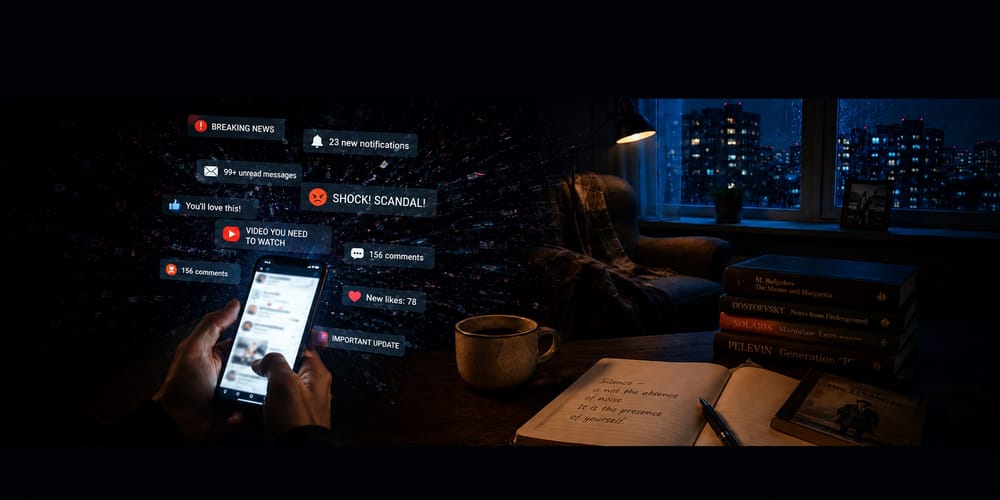
And yet my hand, on some subconscious, muscular level, reaches for my pocket and pulls out the glowing rectangle of my phone.
My thumb performs the familiar upward gesture.
Scroll.
Nothing new.
A couple of posts. A meme. A headline I will forget in five minutes.
I close it. Put the phone face down on the table.
Three minutes later, my hand reaches again.
That was the moment I understood something unpleasant:
my ability to hold focus had been stolen.
My mind, once trained for deep, unhurried attention, had been hacked and rewired.
Once, the internet was a place we visited for half an hour.
Now we have to consciously remember how to leave.
The web used to feel like a quiet library. You walked through it, chose the shelf you needed, found what you were looking for, and left.
Today it feels more like an eastern bazaar, where every stall owner shouts into your face, waves bright fabric, beats a drum, and pulls at your sleeve.
The creators of modern platforms have done something brilliant and terrifying.
They turned natural human curiosity into an automatic, uncontrollable reflex.
Remember how, as children, we waited for New Year’s morning or a birthday gift?
That sweet pause in the chest.
What will be inside?
Now we demand that feeling every few seconds.
The gesture of pulling a feed down and waiting for the little refresh wheel to spin copies the mechanics of a slot machine almost perfectly.
Las Vegas has moved into our pockets.
We have become players who keep pulling the lever, hoping that this time three sevens will appear: a funny picture, a like under a post, or another small dose of news.
And the machine is always with us.
At the dinner table.
In bed before sleep.
Even in the forest, on a walk.
The internet has lost its walls and doors.
It has become continuous.
Part II. The Philosophy of Noise and the Loss of Boredom
Let us rewind memory back to our analog childhood.
What did we do when there was nothing to do?
We were bored.
We sat on windowsills and watched raindrops slide down the glass, merging into little streams.
We stared at the strange patterns on the carpet hanging on the wall, finding monsters, faces, and the outlines of fairy-tale castles.
We read the ingredients on a bottle in the bathroom simply because there was too much time and nothing else to occupy it.
Back then, boredom felt like punishment.
Today I understand that it was a rare and precious treasure — one whose value we only recognised after we had lost it.
From that pure, unfilled boredom came creativity.
From it came depth.
When the mind was left alone with silence, it began to generate its own meanings, its own images, its own dreams.
Our attention belonged to us.
It was not monetised, packaged into targeted segments, analysed by artificial intelligence, or sold through advertising exchanges.
We were the rightful owners of our inner space.
What happens now?
The moment we find ourselves in even thirty seconds of emptiness — in a queue at the checkout, in a lift, at a red light — we grab the phone almost in panic.
We have forgotten how to endure silence.
We are afraid to be alone with our own thoughts, as if something frightening lives down there, in the depths of the mind.
We fill every mental pause with someone else’s digital junk food: short videos, borrowed opinions, endless textual chewing gum.
Blaise Pascal wrote in the seventeenth century: “All of humanity’s problems stem from man’s inability to sit quietly in a room alone.”
If Pascal could see us now, nervously scrolling through the news at three in the morning, he would realise that his metaphor had become literal.
We have filled our inner world with mental smog.
The internet stopped being a quiet place because we ourselves agreed to turn our minds into a public hallway, where terabytes of other people’s unnecessary content stomp around day and night.
Part III. Information Exhaust and Doomscrolling
Our analog consciousness — raised on books, slow conversations, and the measured passage of time — is simply not built for the volume of information we now pour into it.
In the pre-digital era, a person learned about a disaster, earthquake, war, or political crisis on the other side of the planet from the evening news or the morning newspaper.
The information had already settled.
It arrived dry, filtered, and at a human distance.
You felt compassion. You thought about it. And then you continued living your own life.
Between you and a tragedy somewhere far away, there was a healthy buffer of time and space.
Today that buffer is gone.
We watch thousands of other people’s dramas, wars, catastrophes, and local conflicts in real time, almost second by second.
And it would be one thing if we were simply observing.
But social media algorithms are designed to provoke the strongest possible emotional response.
And which emotion holds a person at the screen longest?
Calm joy?
Gratitude?
No.
What holds our attention best is fear, righteous anger, and rage.
That is why your news feed will never be balanced.
It will always push toward you the thing that makes something inside you boil.
You read a terrible headline, and your brain reacts as if the enemy is already standing at your front door.
The ancient fight-or-flight mechanism switches on.
Cortisol rises.
The heart beats faster.
The body prepares to act.
But you cannot run.
You cannot strike.
You are sitting on a sofa with a phone in your hand.
So you do the only thing the system allows you to do.
You keep scrolling.
And scrolling.
And scrolling.
This is doomscrolling.
The psyche burns itself out.
We wake up tired because, during the night, our mind has already “lived through” three global crises and a dozen strangers’ scandals.
We have become a society of chronically overloaded people who have forgotten how to distinguish the important from the urgent — and silence from loneliness.
Part IV. My Personal Non-Aggression Pact with My Smartphone
When I read advice in glossy magazines about “digital detox,” I always feel a slightly sad smile coming on.
The recommendations sound beautiful:
Delete all social media.
Go to a remote village for the weekend.
Meditate while watching the sunset.
Lovely.
And almost completely detached from reality.
We live in 2026.
We cannot simply disappear into the forest.
Our work, our communication with loved ones, our train tickets, banking apps, calendars, maps, documents, and work chats — all of it now lives there, after the login.
To give up the smartphone completely today would mean voluntarily isolating yourself from society.
So I do not believe in radical detox.
I believe in hard, sovereign boundaries.
Not beautiful philosophy.
Ordinary, sometimes boring, domestic discipline.
These are the rules I have developed through trial and error so that I do not lose myself completely in the digital noise.
Here is my personal non-aggression pact with my smartphone — the one I try to sign again every day.
1. A Black-and-White Screen
One of the most unexpectedly effective tricks is to switch the phone screen to grayscale.
Our brain loves bright colours.
Red notification badges, vivid photographs, colourful app icons — all of them hook attention and provoke one more unnecessary glance.
But once the screen becomes monochrome, something strange happens.
The phone immediately loses part of its charm.
The news feed looks duller.
Social media no longer resembles an endless amusement park.
The device becomes what it should have been all along: a tool for communication and information, not the centre of the universe.
Of course, this is not a magic cure.
But for me, it is one of the simplest ways to remind myself that a phone is only a device.
2. The Phone Sleeps in the Hallway
This decision was difficult.
For the first few weeks, I felt genuine phantom withdrawal.
I removed all chargers from the bedroom.
Now my phone sleeps on a dresser in the hallway, near the front door.
That simple physical barrier of five metres changed my mornings completely.
Before, the pattern was painfully familiar.
You open your eyes, reach for the phone to turn off the alarm — and forty minutes later you find yourself deep inside the news feed, with a stiff neck and a heavy head.
Now, if I want to check the phone, I have to physically get out of bed, put on slippers, and leave the room.
In ninety percent of cases, I am simply too lazy to do it immediately.
As a result, the first forty minutes of the day belong to me.
I drink coffee calmly.
Talk to the people close to me.
Watch the city wake up outside the window.
I enter the day with my own thoughts, not with the noise the world has generated while I was asleep.
3. A Paper Alibi and Physical Distance
When I need to write an important text, think through a difficult problem, or simply read a book, I take the phone and move it to another room.
Sometimes I hide it in the farthest drawer of a cupboard.
If the phone is simply lying on the desk — even face down, even on silent — it does not work.
Cognitive scientists have shown that the brain continues to spend part of its working memory suppressing the impulse to pick it up.
You sit there trying to work, while your mind is quietly fighting temptation in the background.
But when the device is out of sight and out of reach, our blessed human laziness comes to the rescue.
To check the phone, you would have to stand up, walk into the hallway, open the drawer...
Fine.
Better finish the chapter.
That is how those clean, deep, uninterrupted thirty or forty minutes of focus return — the kind of minutes from which, once upon a time, our whole life seemed to be made.
Instead of a Conclusion
I want to be completely honest.
I am not a saint.
I am not a guru who has attained digital Zen.
I lose this battle with algorithms almost every day.
I still fall into stupid, meaningless scrolling when I am tired in the evening.
I still catch myself opening an app and freezing five minutes later, unable to remember why I picked up the phone in the first place.
But I know one thing.
I do not want to surrender without a fight.
Protecting attention today is not really about productivity, time management, or even health.
It is about preserving our human identity.
If we completely lose the ability to hold a thought, if we hand over the right to choose what we think about to algorithms and neural networks, very little of our personality will remain.
We will become biological processors for digesting other people’s content and clicking on advertisements.
I wrote this text in my living room not to give a lecture, and not to teach anyone how to live properly.
I wrote it to turn on the light in a dark room and ask those who have stepped inside:
Do you feel this too?
Do you also miss that quiet, finite internet?
How do you cope with this madness today?
Let us search for balance together.
We truly have a lot to discuss.
Come in.
Make yourself comfortable.
My living room is open.
After Login, everything is only beginning.
Stay Updated
New essays from After Login, about once every two weeks. New publications only. No promotional mail.
The Conversation Continues in the Lounge
The article ends here, but the conversation doesn’t. In the project Lounge, you can discuss what you’ve read, disagree with the author, reply to other readers, or start a topic of your own.
After Login, everything is just beginning.