Loneliness in the Digital Age: Why Connection Doesn’t Always Mean Closeness
🎧 Now articles can not only be read, but also listened to.
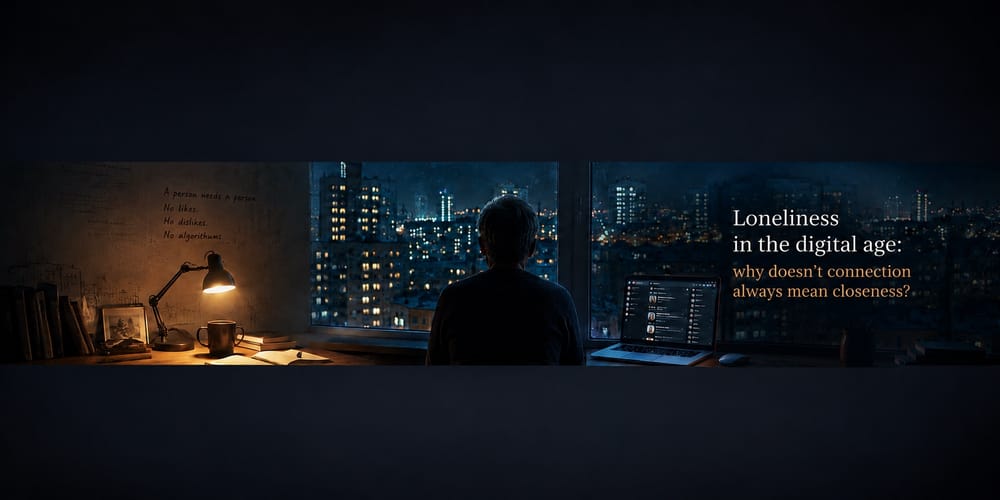
When I look out of my window in the evening, I see the same scene every night: hundreds of glowing windows in tall apartment buildings, and in every second one of them — another small light, the screen of a smartphone or a monitor.
Physically, we are separated only by thin concrete walls. Virtually, we are connected to the entire world.
So why does it feel as if we have become more alone than ever before?
The internet has given us instant communication with any point on the planet. We can send a message across the ocean in a fraction of a second, find people who share our rarest hobbies, and follow the lives of strangers on other continents.
Yet this remarkable achievement quietly reveals its other side.
The paradox of our time is this: while digital technologies erase geographic boundaries, they build new, invisible walls between us. We mistake constant access for genuine closeness — and in our search for another human being behind the screen, we often find only our own reflection.
The Illusion of Connection
Think back to what communication looked like thirty or forty years ago.
To talk to someone, you had to meet in person, write a paper letter, or at least stand beside a landline phone. Every interaction required intention and time.
It had weight.
Today we live in a state of continuous — but shallow — contact.
We are surrounded by likes, brief comments, emojis, and endless social-media stories. Together they create the comforting impression that we are surrounded by a constant, churning stream of other people's lives.
But look more closely at that stream, and something becomes impossible to ignore: we consume information about people instead of communicating with them.
We know what an acquaintance had for breakfast and where they went on holiday, but we have no idea what they feel when they turn off their phone.
A full conversation has been replaced by an exchange of signals.
It is a substitute for closeness: it satisfies us for a short while, then leaves behind a deep, background hunger.
The algorithms behind social platforms are designed to hold our attention, feeding us an endless stream of other people's lives — carefully packaged and sold to us as products.
We look at perfect frames, compare them with our ordinary Tuesdays, and almost without noticing it, sink deeper into isolation.
Nicknames, Masks, and Armor
The digital world has taught us that identity can be constructed.
We choose avatars, invent usernames, filter photographs, and carefully weigh every word we say in public. The internet has become a masquerade where everyone shows their best, edited version.
But every mask has a price.
When we hide behind masks, we deprive ourselves of the chance to be accepted as we truly are — with all our weaknesses, doubts, and imperfections.
We begin to feel that if we show our real selves, the digital world will reject us.
So we put on online armor.
It protects us from criticism, but it also keeps out living human warmth.
We forget that behind every screen, every pixel, and every nickname, there is still a human being.
Someone just as vulnerable.
Just as tired.
Just as hungry for understanding.
When we replace a living face with an app interface, we simplify the person in front of us. We turn them into a line of text, a profile picture, a comment, a username floating on a screen.
This is why cruelty spreads so easily online: it is much easier to hurt pixels on a screen than to look into a real person's eyes and see their pain.
Silence as Medicine
Over the past few years, I have noticed something simple.
Sometimes a five-minute conversation over a cup of coffee gives more real closeness than a week of messaging.
A living voice, the pauses between words, a glance, an accidental smile — these are the small things in which our humanity quietly lives.
Technology tries to digitise this experience, but inevitably loses its essence, the way a low-quality MP3 file loses the depth of a live orchestra.
Loneliness in the digital world is not a technical glitch that can be fixed with a software update.
It is a challenge to our attention and our awareness.
The internet is neither good nor bad in itself. It simply amplifies what we bring into it.
If we use it as a way to escape ourselves, we will find only another portion of noise.
But if we learn to value silence and real conversation, digital space can become a bridge — not a wall.
In Search of Depth
So what can we do?
The answer is not radical Luddism. We do not need to throw away our smartphones or move to a remote village.
We cannot turn history backwards, and we do not need to.
What we need is a new culture of living online — digital hygiene.
1. Quality Over Quantity
One thoughtful conversation a week gives a person far more warmth and a stronger sense of connection than hours of aimless scrolling.
2. The Right to Solitude
It is important to distinguish forced loneliness from chosen solitude.
Solitude is a creative state. It is the quiet space where we are left alone with our own thoughts, free from constant notifications.
It is our right to inner silence — a right we must defend against the engagement algorithms designed to fill it.
3. The Courage to Be Sincere
We should bring warm, living language back into the digital world.
We should move away from template phrases, ask honest questions, and not be afraid to admit our own tiredness, uncertainty, or doubt.
Every time you enter your password, remember this: a login is only a threshold.
Real life does not happen inside software code.
It happens inside us.
Let us remain human — even when thousands of kilometres of fibre-optic cable lie between us.
If these thoughts resonate with you, I would genuinely like to hear yours.
Here, at After Login, we are looking for kindred spirits — people who still believe that a real conversation is worth having.
Pull up a chair.
Our conversation is only beginning.
Stay Updated
New essays from After Login, about once every two weeks. New publications only. No promotional mail.
The Conversation Continues in the Lounge
The article ends here, but the conversation doesn’t. In the project Lounge, you can discuss what you’ve read, disagree with the author, reply to other readers, or start a topic of your own.
After Login, everything is just beginning.